Electricity is an important energy source for production and life in modern society, and ensuring its safe and normal operation is one of the most important tasks of the power system. At present, there are still some disadvantages and problems in the high-voltage test of power transformers in China, especially in the accuracy and reliability management of the test research results, which still need further development and improvement. This article only discusses the relevant analysis issues in depth.
The high voltage test method of power transformer is as follows:
(1) Connect the lead wires according to the wiring diagram of the power transformer to ensure the safety and reliability of the grounding between the transformer and the control box;
(2) Before the high-voltage test of the power transformer, carefully check whether the connection of each part is good, and check whether the voltage regulator in the control box is adjusted to the "zero" position;
(3) After the power system transformer is connected to a power supply and the green traffic indicator light is on, the start control button can be pressed; after the red indicator light is on, wait for the boost;
(4) The tester rotates the handle of the voltage stabilizer in the control box clockwise at a constant speed to slowly increase the voltage, and closely observe the changes displayed by the instrument and the operation of the sample;
(5) After the high-voltage test of the power transformer is completed, quickly adjust the voltage to zero, press the stop button, cut off the power supply, and untie the lead wires connected during the test.
Power transformer high voltage test
In order to ensure the accuracy and authenticity of the high-voltage test results of power transformers, the test content must be reasonably selected in strict accordance with relevant regulations. The high-voltage test of power transformers mainly includes measuring insulation resistance, leakage current, dielectric dissipation factor and AC withstand voltage test. The following is a detailed introduction.
2.1 Measurement of insulation resistance
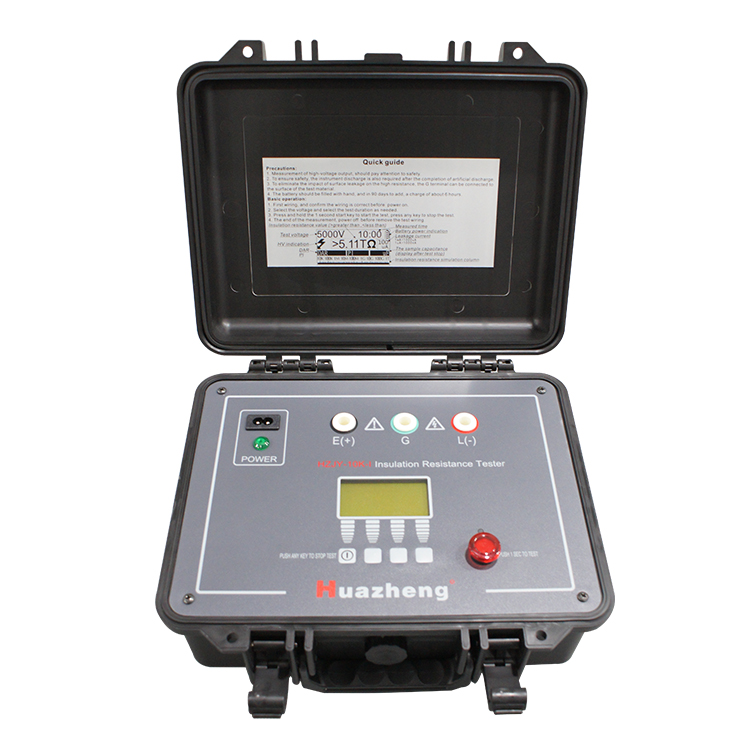
In the high-voltage environment test of power system transformers, the measurement of insulation resistance is the most convenient and simple preventive test. In the measurement of the insulation resistance of the transformer, the overall degree of damp influence of the insulation, the severity of overheating and aging, and the pollution situation can all be directly reflected by the company with the size of the insulation resistance. Taking the insulation resistance of a transformer with a voltage of 110 kV on the high voltage side and a capacity of 31 500 kVA as an example, the absorption ratio of the insulation is closely related to the continuous change and development of the temperature. When the temperature does not reach above 35 °C, the absorption ratio of the dry insulation After the ratio reaches a certain limit, it begins to decrease gradually, and the absorption ratio of the damp insulation will be prone to some irregular structural changes. Therefore, in the measurement of the insulation resistance of transformers, the temperature of the analysis laboratory must be controlled scientifically, rationally and effectively to ensure the authenticity of the measured value of the insulation technology absorption ratio.
2.2 Measurement of leakage current
In the measurement of the leakage current of the power transformer, the leakage current is measured by a digital display leakage current tester. The rated working voltage is generally lower than 2.5kv, which is obviously lower than the rated working voltage of the transformer. If the DC megohm used in the test cannot meet the voltage requirements, the DC high voltage addition can be used to ensure the accuracy of the transformer leakage current measurement. In the case of high voltage, if the leakage current of the transformer is significantly greater than that of the low voltage, it indicates that the high voltage insulation resistance of the transformer is smaller than the low voltage insulation resistance, that is, the transformer itself has quality defects, and the leakage prevention function cannot meet the use requirements.
2.3 Partial discharge test
The partial discharge test of power transformers is a common "non-destructive" test item. Its test methods mainly include: (1) take the power frequency withstand voltage as the pre-excitation magnetic voltage, reduce it to the partial discharge test voltage, and continue for 10 to 15 minutes. Measure the partial discharge; (2) Use the overvoltage in the simulated operation as the pre-excitation voltage, reduce it to the partial discharge test voltage for 1 ~ 1.2h, and measure the partial discharge.
The second test method can be used to measure the partial discharge of power transformers under long-term working voltage to ensure the safe operation of power transformers. In addition, in the partial discharge test of power transformers, the design of the insulation structure, the magnetic field strength of the insulating medium, the surface magnetic fields of the live and ground electrodes, and the processing and handling of the insulating parts should all make the partial discharge lower than the specified value, rather than by Whether the longitudinal insulation of the main body is discharged is the main basis.
In the partial discharge test of power transformers, when the power frequency withstand voltage is used as the pre-excitation voltage, the duration of the test voltage is about 15 minutes. Appropriately prolonging the voltage duration of the partial discharge test has a certain influence on the insulation performance test. If the insulation performance of the transformer is not ideal, it may cause destructive damage to varying degrees. When the overvoltage in the simulated operation is used as the pre-excitation voltage, the standard requires the duration of the partial discharge test voltage to be 1 hour. How long the transformer can withstand the pre-excitation voltage is closely related to the volt-second characteristics of the insulation structure.
In the partial discharge model test of power system transformers, the partial discharge data is usually related to the field strength on the surface of the charged and grounded working electrode material, but not related to the frequency of the power supply. Therefore, the noise of the test research site should be controlled as much as possible. Social distancing should also be practiced continuously in terms of the amount of partial discharge.
2.4 Transformer ratio measurement
The measurement methods of transformer ratio mainly include: double voltmeter method, transformer ratio bridge method, etc. Among them, the transformer ratio bridge method is a commonly used method in field testing. The error can be read directly, the test voltage is adjustable, and it is relatively safe. In the transformation ratio test of power transformers, continuous group tests can be completed synchronously, and the same wiring group is one of the basic conditions for parallel operation of transformers. Judging the wiring combination of the power transformer is also an indispensable content in the high voltage test. Commonly used test methods are: AC voltmeter method, phase meter method, transformer ratio bridge method, DC induction method, group meter method, etc. The group meter is a commonly used special instrument for detecting the group, phase sequence and polarity of power transformers.
2.5 Dielectric loss factor test
In the high-voltage test of power transformers, the dielectric loss factor test is one of the basic insulation preventive test items. In the normal operation of the transformer, the change of the dielectric loss factor is closely related to the size of the insulation loss. During the test, the tester can grasp the overall humidity and deterioration of the transformer insulation, so as to obtain accurate test results.
In the dielectric loss factor test of power transformers, the results are significantly better than the insulation resistance test and leakage current test, mainly because it has little correlation with the test voltage, equipment size and other factors, and the tester can accurately judge the insulation change of the transformer.
2.6 AC withstand voltage test
The AC voltage withstand test of power transformers is mainly used to identify the size of its insulation strength. By using this impact test research method, we can choose to directly reflect the concentrated performance defects of the transformer, so as to ensure the continuous improvement of the insulation performance of the transformer. Avoid serious safety production accidents caused by insulation aging. Before the AC withstand voltage test of China's power transformers, the insulation resistance, leakage current, dielectric loss factor, etc. of the voltage transformer must be carefully measured. After obtaining the test data results of the relevant factors of interest, the organizational culture AC withstand voltage test can be realized. If the statistics and calculation methods of the relevant test design results are unreasonable, it will directly affect the accuracy of the students' AC withstand voltage test results.
Safety Design Method for High Voltage Test of Power Transformer
In the high-voltage test of power transformers, due to the large test voltage required by the enterprise, if we cannot adopt effective safety problem design teaching methods in time, it will directly affect the accuracy of test analysis results and the safety of test technicians. Therefore, in the development process of high-voltage testing of power transformers, more attention must be paid to the research and application of learning methods for students' safety product design, so as to ensure the smooth development and progress of the testing work.
Prevent induced voltage and discharge counterattack
In the high-voltage test of power transformers, effective measures must be taken to prevent induced voltage between the test equipment and other equipment, usually by short-circuiting the test equipment and other equipment and reliably grounding. The high-voltage laboratory should set up a dedicated short-circuit grounding well and grounding system according to the test requirements, and various capacitor equipment that is idle in the laboratory should also be short-circuited and grounded as required.
Since the high-voltage test of China's power transformers is carried out in a relatively closed six-sided shielding environment, there are some phenomena that may cause instantaneous discharge during the test and research process management. Therefore, for high-voltage cable companies in the laboratory, metal Pipe protection, and buried laying. Generally, in this case, the length of the metal resource protection tube should be > 15 m, and it can be connected to the ground electrode every 5 m, so that it is more strictly required to control the occurrence probability of the discharge counterattack phenomenon.
3.2 Reliable grounding
In the high-voltage test of power transformers, it is necessary to ensure that the grounding system of the laboratory is good, and the grounding resistance is generally below 0.5 ω to ensure the safety of test equipment and test personnel. The laboratory should also be regarded as a special equipotential body. All metal instruments and equipment in the laboratory should be well grounded, especially there must be a reliable, safe and stable metal connection between the transformer and the test equipment. In the high-voltage test room, in order to prevent electric shock during the test, the grounding point must be clearly marked.
3.3 Fireproof and explosion-proof
In the high-voltage test of power transformers, it is necessary to prevent overload or short-circuit phenomena during the operation of the transformer. Special attention should be paid to the decomposition and expansion of insulating materials and insulating oil due to factors such as high temperature and electric sparks, which will cause the internal pressure of the transformer to rise sharply, which may cause the explosion of the transformer shell and cause a large amount of insulating oil to spray out and burn, and the oil flow will further expand the fire. Danger. Therefore, during the high-voltage test of power transformers, attention must be paid to the prevention of safety problems to ensure the safety of the test.
4. Overview
In short, the high-voltage test of electric equipment is a high-tech and complicated project. In the high-voltage test of power transformers, it is necessary to choose reasonable test conditions, methods and content, and pay attention to safety design during the test process to ensure the smooth progress of the test and obtain corresponding test data, so as to scientifically judge the comprehensive performance of the transformer.
HZBB-10A Transformer Turns Ratio Tester
HZJY-10K-I Insulation Resistance Tester

 中文
中文
 English

 +86-312-6775656
 +86 13731210226
 sales03@bdhuazheng.com
