As the altitude increases, the pressure of the atmosphere decreases, and the air density and humidity decrease accordingly, which is characterized by:
a. Low air pressure or air density;
b. The air temperature is low and the temperature changes greatly;
c. The absolute humidity of the air is small;
d. The irradiance of the sun is high;
e. Less precipitation;
f. There are more windy days every year;
g. The soil temperature is low and the freezing period is long.
These characteristics have the following four major influence laws on the performance of electrical products, listed as follows:
1. The effect of air pressure or air density reduction
1) Influence on the strength of insulating medium
A decrease in air pressure or air density causes a decrease in the strength of the external insulation. In the range from altitude to 5000m, for every 1000m increase, the average air pressure will decrease by 7.7~10.5kPa, and the external insulation strength will decrease by 8%~13%.
2) Influence on breakdown voltage of electric gap
For the designed product, since its electrical clearance has been fixed, its breakdown voltage will also decrease with the decrease of air pressure. In order to ensure that the product has sufficient breakdown resistance when used in a plateau environment, the electrical clearance must be increased.
3) Effect on corona and discharge voltage
a. High altitude and low air pressure reduce the initial voltage of partial discharge of high-voltage motors, reduce the initial voltage of corona, and cause severe corona corrosion;
b. High altitude and low air pressure reduce the internal air pressure of the power capacitor, resulting in a decrease in the initial voltage of partial discharge;
c. High altitude and low air pressure reduce the inner cavity voltage of the arrester, resulting in a lower power frequency discharge voltage.
4) Influence on arc extinguishing performance of switching devices
The reduction of air pressure or air density will reduce the arc extinguishing performance of the air medium arc extinguishing switch, reduce the on-off capacity and shorten the electrical life. a) The arcing time of the DC arc prolongs as the altitude increases or the air pressure decreases;
b). The arcing distance of DC and AC arcs increases with the increase of altitude or decrease of air pressure.
5) The cooling effect of the medium, that is, the influence of the temperature rise of the product
A reduction in air pressure or air density causes a reduction in the cooling effect of the air medium. For electrical products that use natural convection, forced ventilation or air radiators as the main heat dissipation methods, the temperature rise increases due to the decline in heat dissipation capacity. In the range from altitude to 5000m, for every 1000m increase, the average air pressure decreases by 7.7~10.5kPa, and the temperature rise increases by 3%~10%.
a. The increase rate of temperature rise of static electrical appliances with the increase of altitude is generally within 0.4K per 100m, but for high heating appliances, such as electric furnaces, resistors, electric welding machines and other electrical appliances, the increase rate of temperature rise with altitude increases, Every 100m reaches more than 2K.
b. The temperature rise of power transformers is related to the cooling method as the altitude increases. The increase rate per 100m is: oil-immersed self-cooling, 0.4% of the rated temperature rise; dry-type self-cooling, 0.5% of the rated temperature rise; oil-immersed forced wind Cold, 0.6% of rated temperature rise; dry forced air cooling, 1.0% of rated temperature rise;
c. The increase rate of the temperature rise of the motor with the increase of altitude is 1% of the rated temperature rise per 100m.
6) Influence on the mechanical structure and sealing of the product
a. Cause changes in the physical and chemical properties of low-density, low-concentration, porous materials (such as: electrical insulation materials, heat insulation materials, etc.);
b. Evaporation of lubricants and acceleration of volatilization of plasticizers in plastic products;
c. Due to the increase of the internal and external pressure difference, gas or liquid is easy to leak from the sealed container or the leakage rate increases, and the electrical products with sealing requirements indirectly affect the electrical performance;
d. Cause pressure changes in the pressure vessel, causing the pressure vessel to break easily.
2. The influence of air temperature reduction and temperature change (including daily temperature difference) increase
1) Compensation of plateau ambient air temperature for product temperature rise
Both the average air temperature and the maximum air temperature decrease with the increase of altitude, and the thermal aging life of electrical insulation materials is determined by the average air temperature. The reduction of ambient air temperature on the plateau can partially or fully compensate for the increase in temperature rise of electrical products caused by the reduction of air pressure. The compensation value of ambient air temperature is 0.5K/hm. the
2) Effect of daily temperature difference or temperature change on product structure
The diurnal temperature difference of the plateau air temperature is large. Larger temperature changes make the product shell easily deformed and cracked, and the sealing structure is easily broken. the
3. The influence of the reduction of absolute air humidity
1) The influence of absolute humidity on the external insulation strength
The mean absolute humidity decreases with increasing altitude. When the absolute humidity decreases, the external insulation strength of electrical products decreases, so the humidity correction of power frequency discharge voltage and impulse flashover voltage should be considered. the
The humidity correction is based on the average absolute humidity at zero altitude: 11g/m3, and the specific correction is in accordance with the relevant regulations in GB311.2. the
2) The influence of absolute humidity on motor commutation and carbon brush wear
The reduction of absolute humidity increases the commutation spark of the commutator motor, and at the same time increases the wear rate of the carbon brush of the motor. the
4. Solar irradiance, including the effect of increased ultraviolet irradiance
1) The impact of plateau thermal radiation increase
The maximum solar irradiance at an altitude of 5000m is 1.25 times the corresponding value at a low altitude, and thermal radiation can heat objects. For outdoor electrical products, the increase of solar heat radiation causes a large additional temperature rise on the surface, reduces the material properties of organic insulating materials, deforms materials, and produces mechanical and thermal stress. the
2) The impact of increased ultraviolet radiation on the plateau
The increase rate of ultraviolet irradiance with altitude is much greater than the increase rate of total solar irradiance. At an altitude of 3000m, it has reached twice the corresponding value at low altitudes. Ultraviolet light causes accelerated aging of organic insulating materials, which makes the air easy to ionize, resulting in a decrease in external dielectric strength and corona inception voltage. the
From the above four influences, it can be seen that the design of high and low voltage switchgear used in plateau environment should reduce these influences, improve insulation coordination, and increase electrical clearance at the same time, comprehensively consider the selection of materials and devices, from the structural design and To start with plateau prototype devices and solve related technical problems, the main means of realization is to consider from the product design level.
The main impact of high altitude on electrical equipment is insulation and temperature rise. It can be considered from two aspects:
1. After the altitude is high, it is easy to discharge, so the insulation level should be increased.
2. Due to the thin air, the heat dissipation of air-cooled components is reduced, so the power consumption should be reduced, which should be calculated according to the specific altitude and heat dissipation conditions.
The emphasis on the impact of different electrical equipment is different, so the focus of design is different.
1. High voltage switchgear
As the altitude rises, the air pressure decreases, and the insulation strength of the air weakens, which reduces the external insulation of electrical appliances and has little effect on the internal insulation. Since the factory test of the equipment is carried out at a normal altitude, according to IEC Publication 694, the insulation capacity of the switchgear is evaluated by its rated power frequency withstand voltage value and rated pulse withstand voltage value. When the place of use exceeds 1000M, Appropriate corrections should be made. For 10KV switchgear, its rated voltage is 12KV; rated power frequency withstand voltage (effective value) is 32KV (to isolation distance) and 28KV (between phases and to ground); rated pulse withstand voltage (peak value) It is 85KV (to isolation distance) and 75KV (between phases and to ground). As the altitude rises, the air density decreases and the heat dissipation conditions become worse, which will increase the temperature rise of high-voltage electrical appliances during operation, but the air temperature will gradually decrease with the increase of altitude, which can basically compensate for the increase in altitude. liter impact. But for valve arresters, the situation is more complicated. Since the arrester itself is not sealed, the distance between the valve plates cannot be adjusted, so the discharge voltage of the spark gap is easily affected by the air density, so the altitude should be indicated to the equipment manufacturer, or a high-voltage valve arrester should be used.
2. Dry-type transformer
For epoxy resin dry-type transformers, the Chinese national standard has a clear correction method for the above two factors. According to Articles 3.2.3 and 4.2 of GB6450) "Dry-Type Transformers", for transformers that operate at an altitude exceeding 1000M and are tested at normal altitudes, the temperature rise limit should be reduced accordingly, and the part exceeding 1000M altitude Taking the 500M as the first level, the temperature rise limit is reduced by 2.5% for self-cooled transformers and 5% for air-cooled transformers; the rated short-time power frequency withstand voltage value is increased by 6.25% at the same time.
3. Low-voltage electrical equipment
For low-voltage electrical equipment, the situation is slightly better. According to the JB/Z0103-11 standard and the investigation and research of the scientific research department, the use of the existing ordinary low-voltage electrical appliances in the plateau area is as follows:
1. Temperature: When the existing general low-voltage electrical products are used in plateau areas, the temperature of their dynamic and static contacts, conductors, and coils increases with the increase of altitude. The temperature increase rate increases by 0.1-0.5K for every 100M increase in altitude, but most products are less than 0.4K. In the plateau area, the temperature decreases with the increase of altitude, and the rate of decline is every 100M increase in altitude, and the decrease in temperature is sufficient to compensate for the influence of the increase in altitude on the temperature rise of electrical appliances. Therefore, the rated current value of low-voltage electrical appliances can remain unchanged, and the power supply level can be appropriately reduced for continuous-working high-heat electrical appliances.
2. Insulation withstand voltage: Ordinary low-voltage electrical appliances still have a 60% withstand voltage margin at an altitude of 2500 meters, and tests on domestically used relays and switches have shown that they can be used in other areas at an altitude of 4000M and below. Normal operation under rated voltage.
3. Action characteristics: When the altitude rises, the action characteristics of bimetallic thermal relays and fuses have a little change, but at an altitude of 4000M, they are all within the range of the characteristic curve "band" specified by their technical conditions. RTO and other domestic commonly used The maximum deviation of the melting characteristics of the fuse is within 50% of the allowable deviation. The commonly used domestic thermal relays have better operational stability, and their operating time is significantly shortened with the increase of altitude. According to different models, the normal operating time and 40%-73% respectively. The current setting value can also be adjusted on site to make its action characteristics meet the requirements. Through the research on the nonlinear ambient temperature versus time-current characteristic curve of low-voltage fuses, it is shown that the current-carrying capacity of the melt increases with the decrease of ambient temperature under the same small overload current multiple (ie light overload). , when it is below 20 degrees, the degree of change is greater; and in the case of the same large overload current multiple (that is, short-circuit protection), the change of fusing time with the ambient temperature can not be considered. Therefore, when the fuse switch is used as the overload and short-circuit protection of the distribution line in the plateau area, the selectivity between the upper and lower levels should be specially considered. When using a low-voltage circuit breaker, a certain amount of disconnection and work margin should be left. It can be seen that the reliability and protection characteristics of the fuse are more ideal in the plateau environment.
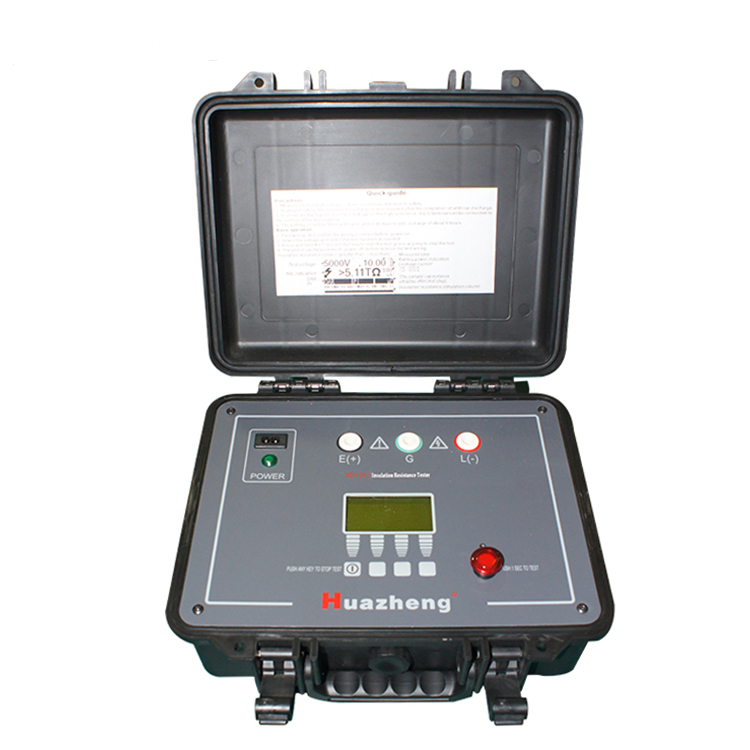
HZJY-5K-I Insulation Resistance Tester

 中文
中文
 English

 +86-312-6775656
 +86 13731210226
 sales03@bdhuazheng.com
