Transformer noise is an inherent characteristic of transformer operation. Relevant national standards have strict sound level limits for it. However, with the improvement of users' awareness of environmental protection, complaints reflecting the excessive noise of the transformer site are gradually increasing, and the reflected noise level It is also often much larger than the factory test data. According to some on-site processing experience, the following reasons are analyzed.
1. The cause of the voltage problem: high voltage will cause the transformer to over-excite, and the sound will increase and be sharp, which will directly and seriously affect the noise of the transformer. Judgment method: first look at the low-voltage output voltage, not the voltmeter on the low-voltage cabinet, the voltmeter only serves as an indicator, and a more accurate multimeter should be used for measurement. Solution: The 10KV voltage in the city is generally high now. According to the output voltage of the low-voltage side, the tap gear should be placed in a suitable gear at this time. On the premise of ensuring the quality of low-voltage power supply, try to adjust the high-voltage tap upward (low-voltage The output voltage is reduced), so as to eliminate the overexcitation phenomenon of the transformer and reduce the noise of the transformer at the same time.
2. The cause of the resonance problem of the fan, casing and other parts: the resonance of the fan, casing and other parts will produce noise, which is generally mistaken for the noise of the transformer. Judgment method: 1) casing: press the aluminum plate of the casing with your hand (or steel plate), see if the noise changes, if there is a change, it means that the shell is resonating. 2) Fan: use a dry long wooden stick to push the shell of each fan to see if the noise changes. If there is a change, it means that the fan is resonating. 3) Other parts: Use a dry long wooden stick to push each part of the transformer (such as: wheels, fan brackets, etc.) to see if the noise changes. If there is a change, it means that the parts are resonating. Solution: 1) Check whether the aluminum plate (or steel plate) of the shell is loose. It may be deformed during installation. You need to tighten the screws of the shell, fix the aluminum plate of the shell, and correct the deformed part. 2) To see if the fan is loose, you need to tighten the fastening bolts of the fan, and place a small piece of rubber between the fan and the fan bracket to solve the problem of fan vibration. 3) If the parts of the transformer are loose, they need to be fixed.
3. The cause of the installation problem: poor installation will aggravate the vibration of the transformer and amplify the noise of the transformer. Judgment method: 1) The foundation of the transformer is not firm or flat (one corner is suspended), or the bottom plate is too thin. 2) Using channel steel to erect the transformer will increase the noise. Solution: 1) The installation unit shall modify the original installation method. 2) An anti-vibration rubber pad is added under the transformer trolley to solve part of the noise.
4. The reason for the influence of the installation environment: the operating environment affects the noise of the transformer, and the unfavorable environment increases the noise of the transformer by 3dB to 7dB. Judgment method: 1) The transformer room is very large and empty, there is no other equipment, and there is echo. 2) The transformer is too close to the wall, less than 1 meter. The transformer is placed at the corner, and the noise reflected by the wall is superimposed on the noise of the transformer, which increases the noise. 3) Originally using the oil changer, the noise of the transformer will be affected after changing to a dry changer. The reason is that the crude oil changer room is relatively small, and there is an oil leakage room and an oil leakage hole. The transformer is like being placed on a speaker. Solution: Some sound-absorbing materials can be properly installed indoors. Goodbye, may we all become better selves in the time when we can't see each other.
5. The reason for the vibration of the busbar bridge: because the side-by-side busbars have a large current passing through them, the busbars vibrate due to the leakage magnetic field. The vibration of the bus bridge will seriously affect the noise of the transformer, which will increase the noise of the transformer by more than 15dB, which is difficult to judge. Generally, users and installation units will mistake it for the noise of the transformer. Judgment method: 1) The noise changes with the load. 2) Use a wooden stick to forcefully push the busbar bridge. If the noise changes, it is considered that the busbar bridge is resonating. 3) The busbar vibrates in the bridge frame, and it is useless to use wooden sticks. It is necessary to open the cover plate of the busbar bridge frame to check whether the busbar is fixed. Solution: 1) Mainly to destroy the resonance conditions of the busbar bridge, tighten or loosen the boom screws. 2) Open the busbar bridge cover and fix the busbar. 3) The low-voltage outgoing line adopts soft connection. 4) Ask the manufacturer of the busbar bridge to solve it. the
6. The reason for the self-resonance of the transformer core: there is electromagnetic attraction caused by magnetic flux leakage at the joints of silicon steel sheets and between the laminations. Judgment method: 1) The noise of the transformer is too loud, and the normal noise is mixed with other noises. 2) Transformer noise becomes wavy. Solution: 1) Tighten the screws on the transformer, including the screws at both ends of the clip, the core-through screws, and the pad pressure screws. 2) Add anti-vibration pads under the transformer trolley to solve part of the noise.
7. The reason for the self-resonance of the transformer coil: when there is a load current passing through the winding, the magnetic flux leakage generated by the load current causes the vibration of the winding. Judgment method: 1) The noise of the transformer is too loud, and the noise is relatively low. 2) When the load of the transformer reaches a certain level, noise begins to appear, and sometimes it appears and sometimes there is no phenomenon. Solution: 1) Tighten all the screws of the spacer block to increase the axial compression force of the coil. 2) Loosen all the screws of the spacer, loosen all the bolts on the outgoing copper bar and the zero line copper bar, shake the low-voltage coil, move the high-voltage coil by 3 to 5 mm, and then tighten all the bolts.
8. The cause of the problem of the nature of the load: the voltage waveform of the transformer is distorted (such as resonance phenomenon), and noise is generated. Judgment method: 1) In addition to the noise of the transformer itself, the noise is also mixed with "clack, cluck" noise. 2) During the operation process, the transformer noise will suddenly increase sharply, and it will return to normal soon. 3) Check whether there are rectification equipment and frequency conversion equipment in the load. Solution: The user may consider adding a device to reduce harmonics.
9. The reason for the lack of phase of the transformer: the transformer cannot be excited normally and generates noise. Solution: 1) If the transformer is powered off, check whether the power supply is short of one phase; 2) Check whether the high voltage fuse of the transformer is blown by one phase.
10. Reasons for poor contact: First, it is caused by poor contact in the high-voltage cabinet. Second, the knife switch is not in place. Judgment method: The transformer emits intermittent and abnormal noise. Solution: 1) Check the contacts and fuses of the high-voltage cabinet and the entire high-voltage circuit. 2) Ask someone from the high-voltage cabinet manufacturer to check.
11. The cause of the problem of the floating potential: the parts such as the clamp channel steel, the nail bolt, and the pull plate of the transformer are all sprayed with blue paint, and the contact of each part is not very good. Generate a floating potential discharge and make a sound. Judgment method: The discharge of the suspension potential makes a very slight "squeak, squeak" sound, which can only be heard by listening carefully. Users often mistake it for the high-voltage or low-voltage discharge of the transformer. Solution: 1) This discharge will not affect the normal operation of the transformer. 2) During power failure maintenance, the paint on the poor contact position can be scraped off, so that the parts of the transformer can be in good contact.
12. The low-voltage line is grounded or short-circuited: When the low-voltage line is grounded or short-circuited, the transformer will make a booming sound; the closer the short-circuit point is to the transformer, the more obvious the sound; if the short-circuit point is close to the transformer, the transformer will make a sound like a tiger. roar
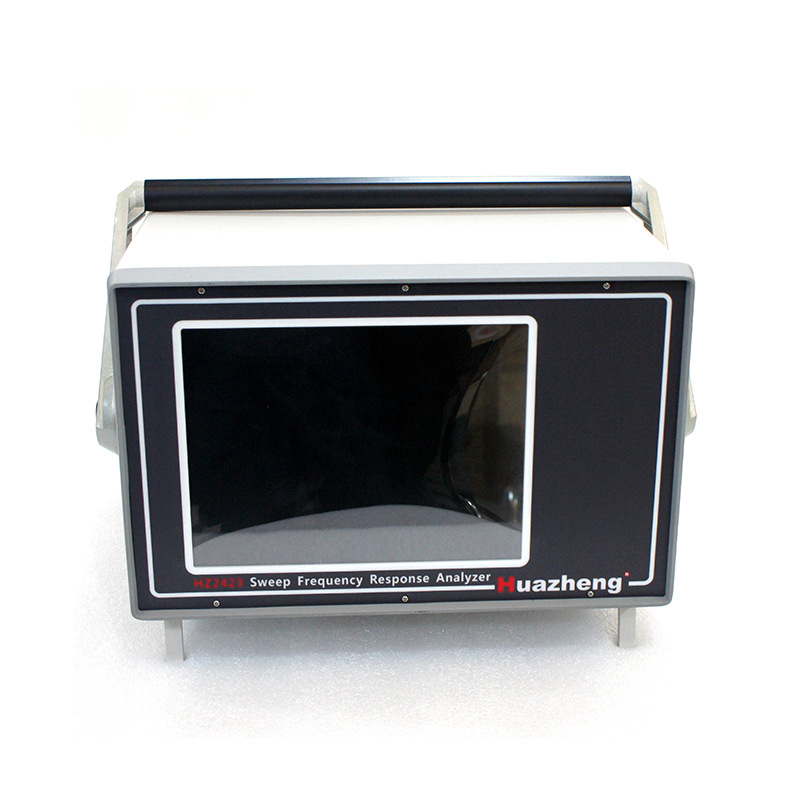
HZ2423 Transformer Winding Deformation Frequency Response Tester

 中文
中文
 English

 +86-312-6775656
 +86 13731210226
 sales03@bdhuazheng.com
