How harmonics are generated
Harmonics produced by power generation equipment.
Harmonics generated by power transmission and distribution systems.
The harmonics generated by the electrical equipment of the power supply system (such as frequency converters, electric furnaces, etc.), among which the harmonics generated by the electrical equipment of the power supply system are the majority.
① Thyristor rectification equipment: Since thyristor rectification has been more and more widely used in electric locomotives, aluminum electrolytic cells, charging devices, switching power supplies, etc., it has caused a large number of harmonics to the power grid. The thyristor rectifier adopts phase-shift control, and what is absorbed from the grid is a sine wave with a missing angle, so what is left for the grid is another part of the sine wave with a missing angle, which obviously contains a large number of harmonics. If the rectifier is a single-phase rectifier circuit, it contains odd harmonic currents, and the third harmonic content can reach 30% of the fundamental wave; when it is connected to a capacitive load, it contains odd harmonic voltages, and its harmonic content varies with increases with the increase in capacitance value. If the rectifier is a three-phase fully-controlled bridge pulse rectifier, the primary side of the transformer and the power supply line contain odd harmonic currents of 5 and above; if it is a 12-pulse rectifier, it also contains odd harmonic currents of 11 and above. Statistics show that: the harmonics generated by the rectifier account for nearly 40% of all harmonics, which is the largest source of harmonics.
② Frequency conversion device: Frequency conversion device is often used in fans, water pumps, elevators and other equipment. Due to the use of phase control, the harmonic components are very complicated. In addition to integer harmonics, they also contain fractional harmonics. The power of such devices is generally Larger, with the increasing use of frequency conversion speed regulation, more and more harmonics are caused to the power grid.
③ Electric arc furnace, calcium carbide furnace: Since the three-phase electrodes of the electric furnace are difficult to touch the uneven furnace material at the same time when heating the raw materials, the combustion is unstable, causing the three-phase load to be unbalanced, and generating harmonic currents, which are transmitted through the delta-connected coils of the transformer. Injected into the grid. The main ones are the 2nd to 7th harmonics, which can reach an average of 8% to 20% of the fundamental wave, and a maximum of 45%.
④ Gas discharge electric light source: Fluorescent lamps, high pressure mercury lamps, high pressure sodium lamps and metal halide lamps are gas discharge electric light sources. Analyzing and measuring the volt-ampere characteristics of this kind of electric light source shows that its nonlinearity is very serious, and some of them also contain negative volt-ampere characteristics, which will cause odd harmonic currents to the power grid.
⑤ Household appliances: TV sets, video recorders, computers, dimming lamps, temperature-adjusting cooking utensils, etc., will generate deep odd-order harmonics due to voltage regulating and rectifying devices. In equipment with windings such as washing machines, electric fans, and air conditioners, the waveform can also change due to changes in unbalanced current. Although the power of these household appliances is small, the quantity is huge, and it is also one of the main sources of harmonics.
The harm of harmonics
Harmonics can cause various hazards, including:
1) Due to the high frequency of harmonics, the skin effect of the wire is aggravated, so the copper loss increases sharply. At the same time, the core loss of the transformer increases sharply because it cannot adapt to the sharply changing magnetic flux.
2) Harmonics will affect the measurement accuracy of the meter. Analyze in principle: the harmonic source converts part of the grid electric energy it absorbs into harmonics and sends it to the grid, so the energy meter will calculate the harmonic energy as power generation, resulting in measurement errors. For mechanical watt-hour meters, it will also slow down due to the high-frequency eddy current resistance generated by high-frequency harmonics. In the case of serious high-order harmonics, it will seriously affect the measurement accuracy of the electric energy meter.
3) Precision electronic equipment (including electronic watt-hour meters) will be seriously disturbed, resulting in malfunction or even burning.
4) The loss and temperature rise of all equipment connected to the grid will increase. Equipment containing capacitors is the most affected, and may even cause equipment damage and accidents such as capacitor explosions.
5) The internal load of the motor causes the output torque to drop due to the reverse order of the harmonics.
6) The relay protection mechanism may malfunction or refuse to operate due to harmonics.
When the harmonic pollution degree of the power supply system is less than the national standard, it usually does not affect the system. If the harmonic control is not carried out, it will often have very serious consequences.
Harmonic suppression method
The suppression of power harmonics is how to reduce or eliminate the harmonic current injected into the system in order to control the harmonic voltage within the limit value. There are three main measures to suppress the harmonic current:
1) Reduce the harmonic content of the harmonic source: that is, take measures on the harmonic source to avoid the generation of harmonics to the greatest extent. This method is more active, can improve the quality of the power grid, and can greatly save the cost of eliminating the influence of harmonics.
Specific methods include:
Increase the number of pulses of the rectifier: the rectifier is the main source of harmonics in the grid, and its characteristic spectrum is:
n=Kp±1, it can be known that the number of pulses p increases, n increases accordingly, and In≈I1/n, so the harmonic current will decrease. Therefore, increasing the number of rectification pulses can smooth the waveform and reduce harmonics. Power electronic devices often design 6-pulse converters as 12-pulse or 24-pulse converters to reduce the harmonic current content on the AC side. Theoretically, the more pulses, the better the suppression effect on harmonics, but the more pulses, the more complicated the structure of the rectifier transformer, the larger the volume, the control and protection of the converter becomes difficult, and the cost increases.
Pulse width modulation method: The basic idea of pulse width modulation technology is to control each conversion moment of the PWM output waveform to ensure the symmetry of a quarter of the waveform. According to the Fourier series expansion of the output waveform, the amplitude of the harmonic to be eliminated is zero and the amplitude of the fundamental wave is a given amount, so as to achieve the purpose of eliminating the specified harmonic and controlling the amplitude of the fundamental wave. The PWM technology currently used has the most Excellent pulse width modulation, improved sinusoidal pulse width modulation, delta modulation, tracking PWM modulation and adaptive PWM control, etc.
The three-phase rectifier transformer adopts Y/Δ or Δ/Y connection: the three-phase rectifier transformer adopts the Y/Δ or Δ/Y connection form, which can eliminate three integer multiples of power harmonics, so that the harmonics injected into the grid The wave current has only 5th, 7th, 11th, etc. harmonics.
2) Absorb harmonic current at the harmonic source: This method is an effective method to suppress existing harmonics. This is the most widely used harmonic suppression method in the power system at present. Currently commonly used methods are passive filter devices and active filter devices. Let's talk about the advantages and disadvantages of these methods, as well as the analysis of market prospects and economic benefits.
Passive harmonic filter device: Passive filters are also called LC filters. They can be divided into single-tuned filters, dual-harmonic filters and high-pass filters. In practical applications, several groups of single-tuned filters and several groups of high-pass filters are often used. The filter forms a filtering device. The single-tuned filter is also called a single-tuned filter circuit. It is mainly composed of a controller, a capacitor, a reactor and a switching switch, as well as its control loop and protection loop. No matter high pressure or low pressure, it is the same. The difference between high-voltage filters and low-voltage filters is mainly that the components used have different withstand voltages, the currents they bear are also different, the required safety distances are also different, and their design and manufacturing are extremely difficult. Big difference.
The amount of filtered harmonics varies depending on the actual situation of each project, generally ranging from 20% to 50% of the original harmonic content of the system. Depending on the specific conditions of the project, several more sets of filters can be installed, and the filtering effect can reach more than 70% of the original harmonic content. However, this requires more effort on the protection circuit, and the protection circuit is relatively complicated. The main structure of passive filtering is to use reactors and capacitors connected in series to form an LC series loop, which is connected in parallel to the system. The resonant frequency of the LC loop is set at the harmonic frequency that needs to be filtered, such as the 5th, 7th, and At the 11th resonance point, the purpose of filtering out the 3rd harmonic is achieved. Now, this is the filtering method that is widely used in the market. Although the filtering effect is poor, the cost is low and it is easy for users to accept. However, if the resonant frequency is not set properly during use, it will resonate with the system.
Active harmonic filtering device: The active harmonic filtering device is developed on the basis of passive filtering. Its filtering effect is good. Within its rated reactive power range, the filtering effect is 100%. It mainly consists of a circuit composed of power electronic components, which generates a harmonic current with the same frequency and amplitude as the harmonics of the system, but with the opposite phase, and offsets the harmonic current in the system. However, due to the limitations of the development of power electronic components withstand voltage and rated current, the cost is extremely high. Its production is also much more complicated than passive filter devices, and the cost is much higher. Its main application scope is the power supply system of the computer control system, especially the power supply system of the office building and the computer control power supply system of the factory.
Prevent the amplification of harmonics by parallel capacitor banks: Parallel capacitor banks in the grid can improve the power factor and adjust the voltage. When harmonics exist, the capacitor bank will amplify the harmonics under certain parameters, endangering the safety of the capacitor itself and nearby electrical equipment. Series reactors can be used, or some branches of the capacitor bank can be changed into filters. The input capacity of the capacitor bank can also be limited to avoid the amplification of harmonics by the capacitor. In order to solve the respective shortcomings of passive filters and active filters and form an ideal harmonic compensation system, active filters and passive filters are generally used together.
Install a static reactive power compensation device: Rapidly changing harmonic sources include electric arc furnaces, electric locomotives, and winches. In addition to generating harmonics, they often cause fluctuations and flickers in the power supply voltage, and some may cause system voltage triples. The phase imbalance will seriously affect the power quality of the public grid. At the harmonic source, a static reactive power compensation device is installed in parallel, which can effectively reduce the amount of fluctuating harmonics. At the same time, it can suppress voltage fluctuations, voltage flicker, three-phase imbalance, and compensate for power factor.
3) Improve the power supply environment: choose a reasonable power supply voltage and keep the three-phase voltage balance as much as possible, which can effectively reduce the impact of harmonics on the power grid. The harmonic source is powered by a larger-capacity power supply point or a higher-level voltage grid, and the ability to withstand harmonics will increase. The harmonic source load is powered by a dedicated line, which reduces the impact of harmonics on other loads, and also helps to suppress and eliminate high-order harmonics.
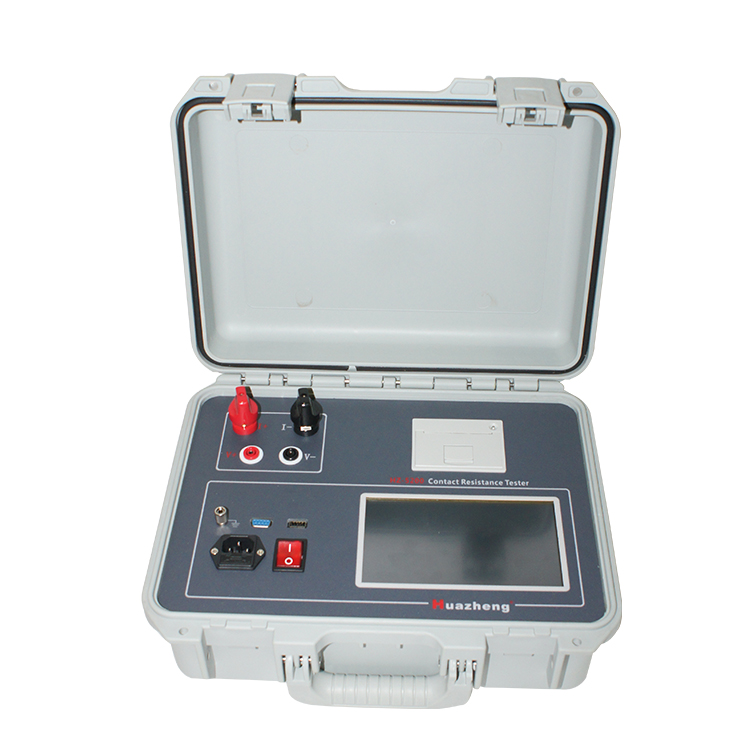
HZ-5200 Contact ResistanceTeste

 中文
中文
 English

 +86-312-6775656
 +86 13731210226
 sales03@bdhuazheng.com
