There are different opinions on how many times the motor's starting current is the rated current, and many of them are based on specific circumstances. For example, more than ten times, 6 to 8 times, 5 to 8 times, 5 to 7 times, etc.
At the moment when the motor starts (that is, the initial moment of the starting process), when the motor's speed is zero, the current value at this time should be its locked-rotor value. The most commonly used Y series three-phase asynchronous motors are stipulated in the JB/T10391-2002 "Y Series Three-Phase Asynchronous Motors" standard. in
The specified value of the ratio of the locked-rotor current and the rated current of the 5.5kW motor is as follows:
When the synchronous speed is 3000r/min, the ratio of locked rotor current to rated current is 7.0;
When the synchronous speed is 1500r/min, the ratio of stalled current to rated current is 7.0;
When the synchronous speed is 1000r/min, the ratio of stalled current to rated current is 6.5;
When the synchronous speed is 750r/min, the ratio of locked rotor current to rated current is 6.0.
The 5.5kW motor has a relatively large power, and the ratio of starting current and rated current of smaller power motors is smaller. Therefore, electrical engineering textbooks and many places say that the starting current of asynchronous motors is 4 to 7 times the rated operating current.
Why is the current relatively large when starting up, but becomes smaller during normal use?
Here we need to understand from the perspective of the motor starting principle and motor rotation principle:
When the induction motor is in a stopped state, from an electromagnetic point of view, it is like a transformer. The stator winding connected to the power supply is equivalent to the primary coil of the transformer, and the closed-circuit rotor winding is equivalent to the short-circuited secondary coil of the transformer; the stator winding There is no electrical connection with the rotor winding, only magnetic connection. The magnetic flux forms a closed circuit through the stator, air gap and rotor core. At the moment of closing, the rotor has not yet started to rotate due to inertia. The rotating magnetic field cuts the rotor winding at the maximum cutting speed - synchronous speed, causing the rotor winding to induce the highest potential possible. Therefore, a large electric potential flows through the rotor conductor. Current, this current generates magnetic energy that cancels the stator magnetic field, just like the secondary magnetic flux of the transformer counteracts the primary magnetic flux.
In order to maintain the original magnetic flux that is compatible with the power supply voltage at that time, the stator automatically increases the current. Because the rotor current is very large at this time, the stator current also increases greatly, even up to 4 to 7 times the rated current. This is the reason for the large starting current. Why is the current small after starting: As the motor speed increases, the speed at which the stator magnetic field cuts the rotor conductor decreases, the induced potential in the rotor conductor decreases, and the current in the rotor conductor also decreases, so the stator current is used to offset the rotor current. The part of the current affected by the magnetic flux also decreases, so the stator current changes from large to small until normal.
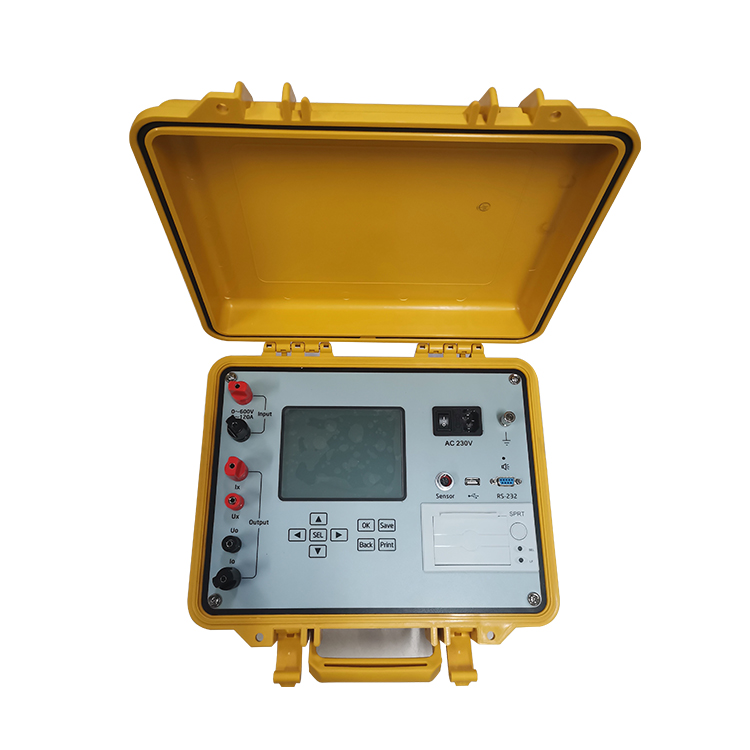
HZ9110 Generator Rotor AC Impedance Tester

 中文
中文
 English

 +86-312-6775656
 +86 13731210226
 sales03@bdhuazheng.com
