There are many ways to operate the neutral point of the power system: ungrounded, grounded through a resistor, grounded through an arc suppression coil, or directly grounded. There are three main neutral point grounding methods currently used in my country's power system: ungrounded, arc suppression coil grounded and direct grounded. Small resistance grounding systems are widely used abroad, and some of them have begun to be used in my country.
1. Three-phase system with ungrounded (insulated) neutral point
The value of the capacitance current of each phase is equal but the phase difference is 120°. The vector sum is equal to zero. There is no capacitance current passing through the ground. The potential of the neutral point to the ground is zero, that is, the potential of the neutral point and the ground is consistent. At this time, whether the neutral point is grounded or not has no effect on the phase-to-ground voltage. However, when the phase-to-ground capacitances of the ungrounded system are unequal, even under normal operating conditions, the potential of the neutral point to ground is no longer zero. This situation is usually called neutral point displacement, that is, neutral point It's not ground potential anymore. This phenomenon is mostly caused by the asymmetric arrangement of overhead lines and incomplete transposition.
In a three-phase system with an ungrounded neutral point, when one phase is grounded: First, the voltage to ground of the two ungrounded phases rises to √3 times, which is equal to the line voltage. Therefore, in this system, the phase-to-ground voltage The insulation level should be designed according to the line voltage. Second, the voltage magnitude and phase between each phase remain unchanged, and the balance of the three-phase system is not destroyed, so it can continue to operate for a period of time. This is the biggest advantage of this system. However, long-term grounding operation is not allowed, especially in power systems with direct power supply from generators, because the ground voltage of the ungrounded phase rises to the line voltage, and running one phase grounded for too long may cause a two-phase short circuit. Therefore, in this kind of system, insulation monitoring or grounding protection devices should generally be installed. When a single-phase grounding occurs, a signal can be sent out, allowing the personnel on duty to take measures quickly to eliminate the fault as soon as possible. The maximum time that a one-phase grounded system is allowed to continue operating shall not exceed 2 hours. Third, the current passing through the ground point is capacitive, and its size is three times the original capacitance current to the ground. This capacitive current is not easy to extinguish, and may cause arc analysis at the ground point, and periodic extinguishment and reoccurrence of arcs. Continuous intermittent arcs caused by arc grounding are more dangerous and may cause resonance in the line to produce overvoltage, damage electrical equipment or develop a phase-to-phase short circuit. Therefore, in this kind of system, if the ground current is greater than 5A, the generator, transformer and motor should be equipped with ground protection devices that can trip.
2. Three-phase system with neutral point grounded through arc suppression coil
Although the three-phase system with ungrounded neutral point mentioned above can continue to supply power when a single-phase ground fault occurs, it cannot supply power when the single-phase ground fault current is large, such as greater than 10A in a 35kV system and greater than 30A in a 10kV system. Continue to supply power. In order to overcome this shortcoming, the method of grounding via arc suppression coil appeared. At present, in the 35kV power grid system, this method of grounding the neutral point through the arc suppression coil is widely used.
The arc suppression coil is an adjustable inductor coil with an iron core, installed at the neutral point of the transformer or generator. When a single-phase ground fault occurs, an inductor current that is nearly equal in magnitude to the ground capacitor current but in the opposite direction can be formed. This inductor current that lags the voltage by 90° compensates for each other by the capacitor current that leads the voltage by 90°, and finally causes the current to flow through the ground. The current becomes so small that it is equal to zero, thereby eliminating arcing at the ground and the hazards it may cause. This is how the arc suppression coil got its name. When the capacitor current is equal to the inductor current, it is called full compensation; when the capacitor current is greater than the inductor current, it is called undercompensation; when the capacitor current is less than the inductor current, it is called overcompensation. Generally, overcompensation is used so that the arc suppression coil has a certain margin and does not cause resonance and overvoltage.
3. The neutral point is directly grounded
A system with a directly grounded neutral point is a large current grounding system. Generally, the current passing through the ground point is relatively large, which may burn out electrical equipment. After a fault occurs, the relay protection will act immediately to trip the switch and eliminate the fault. At present, most systems above 110kV in my country use the neutral point to be directly grounded.
The neutral point grounding methods of power systems with different levels are also different. Generally, the selection is based on the following principles: for power grids above 220kV, the neutral point direct grounding method is adopted; for 110kV grounding networks, most of the 110kV grounding grids adopt the neutral point direct grounding method, and a small number of them adopt the neutral point direct grounding method. Arc suppression coil grounding method; 20-60kV power grid, based on power supply reliability, adopts arc suppression coil grounding or non-grounding method. However, when the single-phase grounding current is greater than 10A, the arc suppression coil grounding method can be used; for 3-10kV power grids, power supply reliability and fault consequences are the most important considerations, and the neutral point ungrounded method is often used. However, when the grid capacitance current is greater than 30A, grounding through arc suppression coils or grounding through resistors can be used; below 1kV, that is, 220/380V three-phase four-wire low-voltage power grids, from a safety point of view, the neutral point is directly grounded. This way, it can prevent dangerous voltage (to ground) exceeding 250V when one phase is grounded. In special places, such as explosion-risk places or underground mines, the neutral point is not grounded. At this time, one phase or neutral point should have a breakdown fuse to prevent the danger caused by high voltage jumping into low voltage.
4. Advantages of neutral point grounding
In the 220/380V three-phase four-wire low-voltage distribution network, the neutral point of the distribution transformer is mostly grounded. This is mainly because this has the following advantages: First, under normal power supply conditions, the voltage of the phase line to ground can be maintained unchanged, so that two different voltages of 220/380V can be provided to the outside (to the load) to meet the requirements of Single-phase 220V (such as lights, electric heating) and three-phase 380V (such as motors) have different electricity needs. Second, if the neutral point is not grounded, when a single phase is grounded, the voltage to ground of the other two phases will increase to several times the phase voltage. After the neutral point is grounded, the voltage to ground of the other two phases will still be the phase voltage. In this way, the contact voltage of the human body can be reduced, and the insulation requirements for electrical equipment can also be appropriately reduced, which is beneficial to manufacturing and reducing costs. Third, it can avoid the danger of high-voltage electricity escaping to the low-voltage side. After the above grounding is implemented, if the insulation between the high and low voltage coils is damaged and causes serious leakage or even short circuit, the high voltage electricity can form a closed loop through the grounding device, causing the upper level protection to trip and cut off the power supply, thereby avoiding the low voltage side. Workers were injured by high-voltage electricity or equipment was damaged. Therefore, the distribution neutral point of the low-voltage power grid is generally directly grounded.
The neutral point is divided into power supply neutral point and load neutral point. It only appears when the three-phase power supply or load is connected in a Y shape. For the power supply, the common connection point where the first or last ends of the three-phase coils are connected together is called the neutral point of the power supply, or the midpoint for short; and the wire leading from the neutral point of the power supply is called the neutral line, or the neutral line for short. , often represented by N. Three-phase four-wire neutral point ungrounded system and three-phase four-wire neutral point grounded system.
Generally speaking, when the neutral point is grounded, it is called the neutral line; when it is not grounded, it is called the neutral line.
The three points of the power distribution system are grounded together. In order to prevent the power grid from being harmed by overvoltage, the neutral point of the transformer, the casing of the transformer, and the ground down conductor of the arrester are usually connected to a grounding device, which is also called three-point common grounding. This can ensure the safe operation of the transformer. When struck by lightning, the arrester operates, leaving only the residual voltage of the arrester on the transformer shell, reducing the voltage on the ground body.
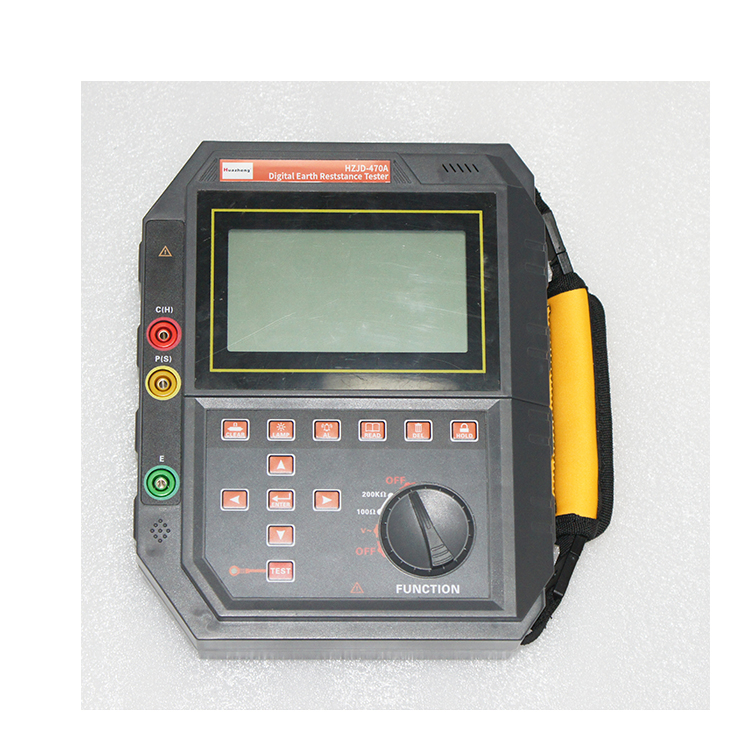
HZJD-470A Digital Ground Resistance Tester

 中文
中文
 English

 +86-312-6775656
 +86 13731210226
 sales03@bdhuazheng.com
