1. What is ground resistance?
Ground resistance is the resistance encountered when current flows from a grounding device to the earth and then flows through the earth to another grounding body or disperses to a distance. It includes the resistance of the grounding wire and the grounding body itself, and the contact between the resistance of the grounding body and the earth. Resistance and the resistance of the earth between two ground bodies or the resistance of the earth from the ground body to infinity. The size of the ground resistance directly reflects the degree of contact between the electrical device and the "ground" and also reflects the design of the ground network. Under conditions such as single-point grounding systems and strong interference, the measurement method of auxiliary earth electrode can be used for measurement. Ground resistance is mainly divided into the following three types.
1. Protective grounding: The metal shell of electrical equipment, concrete, poles, etc. may be charged due to insulation damage. Grounding is provided to prevent this situation from endangering personal safety.
2. Anti-static grounding: Ground flammable oil and natural gas storage tanks and pipelines, electronic equipment, etc. to avoid the risk of static electricity.
3. Lightning protection grounding: In order to introduce lightning into the ground, the grounding end of the lightning protection equipment (lightning rod, etc.) is connected to the earth to eliminate the harm of lightning overvoltage to electrical equipment, personal property, and grounding. It is also called overvoltage protection grounding.
2. Several methods for measuring ground resistance
1. Two-line method
Conditions: There must be a known ground with good grounding, such as PEN, etc. The measured result is the sum of the resistances of the measured ground and the known ground. Assuming that the known ground is much smaller than the resistance of the measured ground, the measurement results can be used as the results of the measured ground.
Suitable for: areas with dense buildings or cement floors that are sealed and unable to drive ground piles.
Wiring: E+ES is connected to the measured ground, H+S is connected to the known ground.
2. Three-line method
Conditions: There must be two ground rods: an auxiliary ground and a detection electrode. The distance between each grounding electrode shall not be less than 20 meters. The principle is to add current between the auxiliary ground and the measured ground, and measure the voltage drop between the measured ground and the detection electrode. The measurement results include measuring the resistance of the cable itself.
Suitable for: foundation grounding, construction site grounding and lightning protection grounding.
Wiring: S is connected to the detection electrode, H is connected to the auxiliary ground, E and ES are connected and then connected to the measured ground.
3. Four-wire method
Basically the same as the three-wire method, it is replaced by the three-wire method when measuring low ground resistance and eliminating the influence of measurement cable resistance on measurement results. During measurement, E and ES must be directly connected to the measured ground separately. This method is the most accurate of all ground resistance measurement methods.
4. Single clamp measurement
Measure the ground resistance at each ground point in a multi-point ground, and do not disconnect the ground connection to avoid risk.
Suitable for: multi-point grounding, the connection cannot be disconnected, and the resistance of each connection point is measured.
Wiring: Use a current clamp to monitor the current at the measured connection address.
5. Double clamp method
Conditions: Multi-point grounding, no auxiliary ground stakes, single grounding measurement.
Wiring: Use the current clamp specified by the manufacturer to connect to the corresponding socket, and clamp the two clamps on the ground conductor. The distance between the two clamps should be greater than 0.25 meters.
3. How to use the ground resistance tester
1. Preparation for using ground resistance tester
① Familiarly read the instruction manual of the ground resistance measuring instrument and fully understand the structure, performance and usage of the instrument.
② Prepare all the tools and all instrument accessories necessary for measurement, and scrub the instrument and grounding probe clean. Especially the grounding probe, be sure to clean the dirt and rust stains on its surface that affect the conductivity.
③ Disconnect the connection point between the grounding trunk line and the grounding body or the connection points of all grounding branches on the grounding trunk line, so that the grounding body becomes independent from any connection.
2. Measurement steps using a ground resistance tester
(1) Insert two grounding probes into the ground 20m and 40m away from the grounding body along the radiation direction of the grounding body, with a penetration depth of 400mm.
(2) Place the grounding resistance measuring instrument flatly near the grounding body and perform wiring. The wiring method is as follows:
① Use the shortest dedicated wire to connect the grounding body to the terminal "E1" of the grounding measuring instrument (a measuring instrument with three terminal buttons) or to the common terminal after short circuiting C2 and "(a measuring instrument with four terminal buttons).
② Use the longest special wire to connect the measuring probe (current probe) 40m away from the ground body to the connecting button "C1" of the measuring instrument.
③ Use the remaining length of the special wire in the center to connect the measuring probe (potential probe) ⒛m away from the ground body to the terminal "P1" of the measuring instrument.
(3) After placing the measuring instrument horizontally, check whether the pointer of the galvanometer points to the center line. Otherwise, adjust the "zero adjuster" to make the pointer of the measuring instrument point to the center line.
(4) Set the "magnification scale" (or coarse adjustment knob) to the maximum multiple, and slowly rotate the generator handle (the pointer begins to shift), and at the same time rotate the "measuring dial" (or fine adjustment knob). Adjust the knob) so that the galvanometer pointer points to the center line.
(5) When the pointer of the galvanometer is close to balance (the pointer is close to the center line), accelerate the swing handle to make the rotation speed reach more than 120r/min, and adjust the "measurement dial" at the same time to make the pointer point to the center line.
(6) If the reading of the "measuring dial" is too small (less than 1) and difficult to read accurately, it means that the magnification scale multiple is too large. At this time, the "magnification scale" should be set to a smaller multiple, and the "measurement dial" should be readjusted so that the pointer points to the center line and an accurate reading is taken.
(7) Calculate the measurement results, that is, R = "magnification scale" reading × "measurement dial" reading.
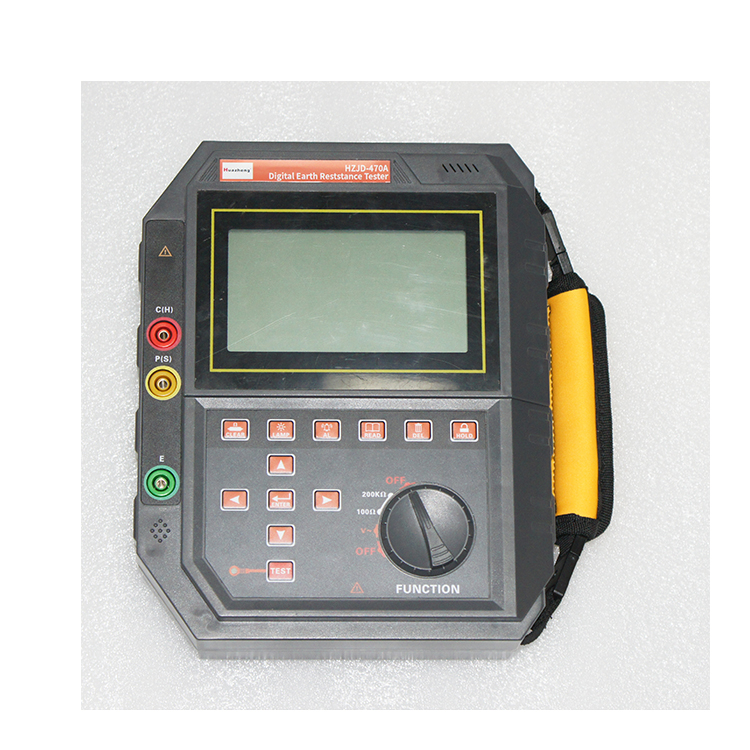
HZJD-470A Digital Ground Resistance Tester

 中文
中文
 English

 +86-312-6775656
 +86 13731210226
 sales03@bdhuazheng.com
