Insulation resistance testers are commonly known as megohmmeters, or megohmmeters, high resistance meters, insulation resistance meters, etc. Insulation resistance testers are widely used to detect the insulation resistance of electric power and electrical equipment. They are of great significance to ensure product quality and equipment and personal safety during operation.
The insulation performance of electrical products is one of the important indicators for evaluating the quality of insulation, which is reflected by insulation resistance.
At present, in the standards of household electrical appliances, they usually only stipulate the thermal insulation resistance, but not the insulation resistance value under normal conditions. The insulation resistance value under normal conditions is determined by the enterprise standards. If the normal insulation resistance value is low, it indicates that there may be some hidden danger or damage in the insulation structure. If the insulation resistance of the motor winding to the shell is low, it may be caused by damage to the insulation of the winding's distribution slot during wire embedding. When using electrical appliances, due to sudden power-on or power-off or other reasons, the circuit will generate overvoltage and breakdown will occur in the damaged insulation, causing personal safety or threats.
How to use the insulation resistance tester:
(1) The terminal button (or jack) must be selected correctly
The red test lead connecting wire should be connected to the red terminal button (or into the jack marked with "+"), and the black test lead connecting wire should be connected to the black terminal button (or into the jack marked with "-") , some are equipped with AC and DC 2500 volt measurement terminals. When in use, the black test rod is still connected to the black terminal (or into the "-" jack), and the red test rod is connected to the 2500 volt terminal (or inserted into the hole).
(2) The selection of the transfer switch position must be correct
Turn the switch to the required position according to the measurement object. If measuring current, turn the switch to the corresponding current range and measure voltage to the corresponding voltage range. Some panels have two switches, one to select the measurement type and the other to select the measurement range. When using, you should first select the measurement type and then select the measurement range.
(3) The range selection must be appropriate
According to the approximate range of the measurement, turn the switch to the appropriate range for that type. When measuring voltage or current, keep the pointer within one-half to two-thirds of the range for more accurate readings.
(4) Take correct readings
There are many scales on the dial of the megohmmeter, and they are suitable for different measured objects. Therefore, when measuring, while reading on the corresponding scale, you should also pay attention to the coordination between the scale reading and the measuring range to avoid errors.
(5) Correct use of ohm gear
①Select the appropriate magnification file:
When measuring resistance, the magnification gear should be selected so that the pointer stays in the thinner part of the scale. The closer the pointer is to the middle of the scale, the more accurate the reading will be. The further to the left, the more crowded the scale line will be, and the more accurate the reading will be. Difference.
②Zero adjustment:
Before measuring resistance, you should touch the two test rods together and turn the "zero knob" at the same time so that the pointer just points at the zero position of the ohm scale. This step is called ohm zero adjustment. Each time you change the ohm level, repeat this step before measuring resistance to ensure measurement accuracy. If the pointer cannot be adjusted to zero, the battery voltage is insufficient and needs to be replaced.
③Do not measure resistance while charging:
When measuring resistance, the megohmmeter is powered by dry batteries. The resistance being measured must not be charged to avoid damage to the meter head. When using the ohm mode, do not short-circuit the two test rods to avoid wasting the battery.
(6) Pay attention to operational safety
① When using this product, be careful not to touch the metal part of the test rod with your hands to ensure safety and measurement accuracy.
② When measuring higher voltage or larger current, do not turn the transfer switch while it is powered, otherwise the switch may burn out.
③After use, turn the switch to the AC voltage high-range range. This range is safe for the megohmmeter to prevent damage to the megohmmeter due to negligence during next measurement.
④When the test rod comes into contact with the circuit under test, a comprehensive inspection should be made to see if the position of each part is wrong.
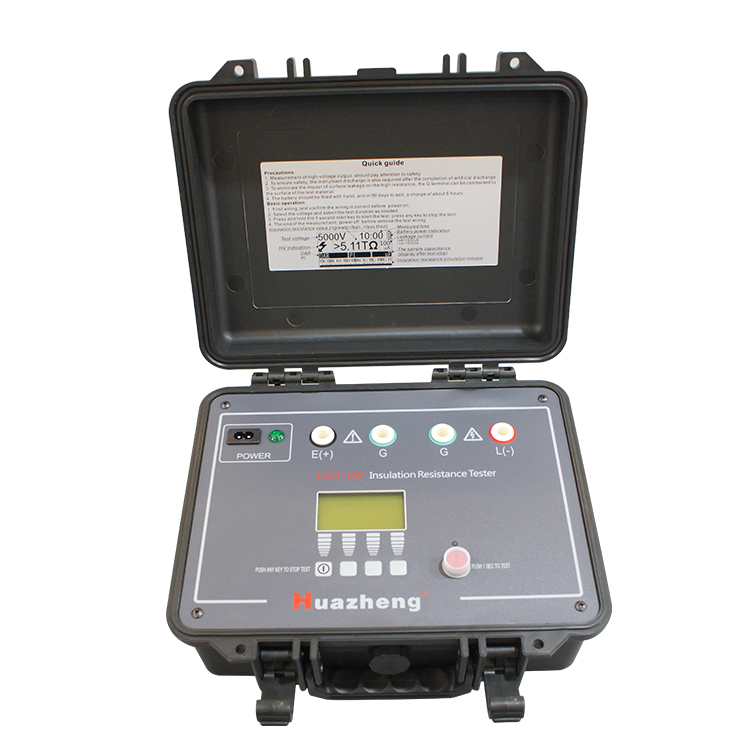
HZJY-15K Portable 15kv Ohm Meter

 中文
中文
 English

 +86-312-6775656
 +86 13731210226
 sales03@bdhuazheng.com
