1. PLC self-fault judgment
Generally speaking, PLC is an extremely reliable device with a low failure rate. The probability of PLC CPU and other hardware being damaged or software running errors is almost zero; if the PLC input point is not caused by strong current intrusion, it will almost not be damaged; if the normally open point of the PLC output relay is not short-circuited by the peripheral load or unreasonably designed , the load current exceeds the rated range, and the life of the contacts is also very long.
Therefore, when we look for electrical fault points, we should focus on the peripheral electrical components of the PLC. Do not always suspect that there is a problem with the PLC hardware or program. This is very important for quickly repairing the faulty equipment and quickly resuming production. Therefore, what the author talks about For electrical troubleshooting of PLC control loops, the focus is not on the PLC itself, but on the peripheral electrical components in the loop controlled by the PLC.
2. Selection of input and output (I/O) modules
Output modules are divided into transistor, triac, and contact types.
The transistor type has the fastest switching speed (generally 0.2ms), but the smallest load capacity, about 0.2~0.3A, 24VDC. It is suitable for equipment with fast switching and signal connection. It is generally connected with signals such as frequency conversion and DC devices. Pay attention to the leakage of the transistor. Effect of current on load.
The advantages of the silicon controlled thyristor are that it has no contacts, has AC load characteristics, and has a small load capacity.
The relay output has AC and DC load characteristics and has large load capacity. In conventional control, relay contact type output is generally used first. The disadvantage is that the switching speed is slow, usually around 10ms, which is not suitable for high-frequency switching applications.
3. Grounding problem
The grounding requirements of the PLC system are relatively strict. It is best to have an independent dedicated grounding system. It is also important to note that other equipment related to the PLC must also be reliably grounded. When multiple circuit ground points are connected together, unexpected current flow can occur, causing logic errors or damaging the circuit.
The reason for different ground potentials is usually that the ground points are separated too far in the physical area. When devices that are far apart are connected together by communication cables or sensors, the current between the cable and the ground becomes smaller. Will flow through the entire circuit, even within a short distance, the load current of large equipment can vary between it and the ground potential, or directly produce unpredictable currents through electromagnetic effects.
Between power supplies at incorrect grounding points, it is possible for destructive currents to flow in the circuit, destroying equipment.
PLC systems generally use one-point grounding. In order to improve the ability to resist common mode interference, shielded floating technology can be used for analog signals, that is, the shielding layer of the signal cable is grounded at one point, the signal loop is floating, and the insulation resistance to the earth should be no less than 50MΩ.
4. Eliminate line-to-line capacitance to avoid malfunctions
There is capacitance between each conductor of the cable, and qualified cables can limit this capacitance within a certain range. Even if it is a qualified cable, when the cable length exceeds a certain length, the capacitance value between each line will exceed the required value. When this cable is used for PLC input, the capacitance between lines may cause malfunction of the PLC. , many incomprehensible phenomena will occur.
The main manifestations of these phenomena are: the open wiring is correct, but the PLC has no input; the inputs that the PLC should have are not there, but the inputs that should not be there are, that is, the PLC inputs interfere with each other. To solve this problem, it should be done:
1. Use cables with cable cores twisted together;
2. Try to shorten the length of the cable used;
3. Use separate cables for inputs that interfere with each other;
4. Use shielded cables.
5. Anti-interference processing
The environment of industrial sites is relatively harsh and there are many high and low frequency interferences. These interferences are generally introduced into the PLC through cables connected to field devices. In addition to grounding measures, some anti-interference measures should be taken during cable design selection and laying construction:
1. Analog signals are small signals and are easily affected by external interference. Double-layer shielded cables should be used; high-speed pulse signals (such as pulse sensors, counting discs, etc.) should use shielded cables to prevent external interference and prevent Interference of high-speed pulse signals to low-level signals;
2. The frequency of communication cables between PLCs is relatively high. Generally, the cables provided by the manufacturer should be used. If the requirements are not high, shielded twisted pair cables can be used;
3. Analog signal lines and DC signal lines cannot be routed in the same wire trough as AC signal lines;
4. The shielded cables leading in and out of the control cabinet must be grounded and should be directly connected to the equipment without passing through the terminal blocks;
5. AC signals, DC signals and analog signals cannot share the same cable, and power cables should be laid separately from signal cables;
6. During on-site maintenance, methods to solve interference include: using shielded cables for the interfered lines and relaying them; adding anti-interference filtering codes to the program.
6. Mark input and output to facilitate maintenance
PLC controls a complex system. What you can see are two staggered rows of input and output relay terminals, corresponding indicator lights and PLC numbers, just like an integrated circuit with dozens of pins. If anyone does not look at the schematic diagram to troubleshoot faulty equipment, he will be helpless and the fault finding speed will be extremely slow.
In view of this situation, we draw a table based on the electrical schematic diagram and paste it on the console or control cabinet of the equipment, indicating the corresponding electrical symbol and Chinese name of each PLC input and output terminal number, which is similar to the integrated circuit tube. Description of the function of the foot.
With this input and output table, electricians who understand the operation process or are familiar with the ladder diagram of this equipment can start maintenance. But for those electricians who are not familiar with the operating process and cannot read ladder diagrams, they need to draw another table: PLC input and output logic function table. This table actually illustrates the logical correspondence between the input loop (trigger element, associated element) and the output loop (executive element) during most operations.
Practice has proved that if you can skillfully use the input-output correspondence table and the input-output logic function table, you can troubleshoot electrical faults easily without drawings.
7. Infer faults through program logic
There are many types of PLCs commonly used in industry. For low-end PLCs, the ladder diagram instructions are similar. For mid-to-high-end machines, such as S7-300, many programs are compiled using language tables. Practical ladder diagrams must be annotated with Chinese symbols, otherwise it will be difficult to read. It seems easier if you can have a general understanding of the equipment process or operation process before looking at the ladder diagram.
When conducting electrical fault analysis, the back-checking method or the back-inference method is generally used, that is, based on the input-output correspondence table, find the output relay corresponding to the PLC from the fault point, and start to back-check the logical relationship that satisfies its action. Experience shows that if one problem is found, the fault can basically be eliminated, because there are not many fault points where two or more faults occur on the equipment at the same time.
8. Make full and reasonable use of software and hardware resources
1. Instructions that do not participate in the control loop or have been input before the loop do not need to be connected to the PLC; when multiple instructions control a task, they can be connected in parallel outside the PLC first and then connected to an input point;
2. Try to make full use of the internal functional soft components of the PLC and fully call the intermediate states to make the program complete and coherent and easy to develop. At the same time, it also reduces hardware investment and reduces costs;
3. If conditions permit, it is best to make each output independent, which facilitates control and inspection, and also protects other output circuits; when an output point fails, it will only cause the corresponding output circuit to lose control;
4. If the output is a forward/reverse controlled load, not only must it be interlocked from the PLC internal program, but measures must be taken outside the PLC to prevent the load from moving in both directions;
5.PLC emergency stop should be cut off using an external switch to ensure safety.
9. Other matters needing attention
1. Do not connect the AC power cord to the input terminal to avoid burning the PLC; the ground terminal should be independently grounded and not connected in series with the ground terminals of other equipment. The cross-sectional area of the ground wire should not be less than 2mm2;
2. The auxiliary power supply has small power and can only drive low-power equipment (photoelectric sensors, etc.);
3. Some PLCs have a certain number of occupation points (i.e. empty address terminals), do not connect the lines;
4. When there is no protection in the PLC output circuit, protective devices such as fuses should be used in series in the external circuit to prevent damage caused by load short circuit.
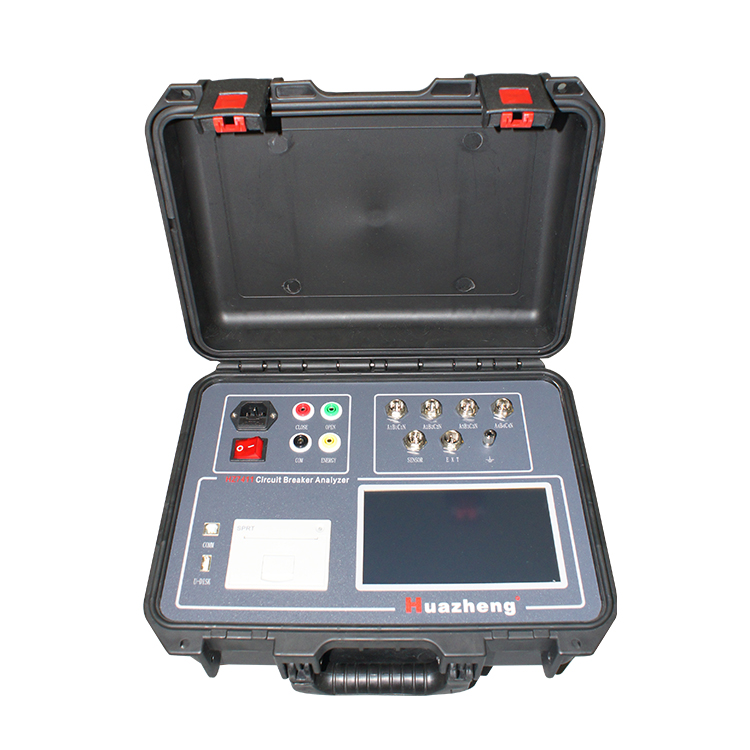
HZ7411 Circuit Breaker Dynamic Characteristic Tester

 中文
中文
 English

 +86-312-6775656
 +86 13731210226
 sales03@bdhuazheng.com
