The windings and iron core of the transformer are the main components that transmit and transform electromagnetic energy. Ensuring their reliable operation is a matter of concern. Statistics show that failures caused by iron core problems account for the third place in total transformer accidents. The manufacturing department has paid attention to the defects in the transformer core, and has made technical improvements in monitoring the grounding of the metal hose and stainless steel hose of the core and ensuring one point of grounding.
1.
The reason why the iron core needs a little grounding when it is normal
When the transformer is operating normally, there is an electric field between the charged windings and the tank, and the iron core and other metal components are in this electric field. Due to the uneven distribution of capacitance and different field strengths, if the metal hose and stainless steel hose of the iron core cannot be grounded, charging and discharging will occur, destroying the insulation strength of solid insulation and oil, so the iron core must have a point that can be grounded.
The iron core is composed of silicon steel sheets and metal hoses and stainless steel hoses. In order to reduce eddy currents, there is a certain insulation resistance between the sheets (generally only a few ohms to dozens of ohms). Because the capacitance between the sheets is extremely large, it can It is regarded as a path, so only one point of grounding in the core can clamp the potential of the entire stack of core laminations to ground potential.
When the iron core or its metal components are grounded at two or more points (multiple points), a closed loop will be formed between the ground points, which will link part of the magnetic flux, induce electromotive force, and form a loop, resulting in local Overheating may even burn the iron core.
The transformer core must be grounded only at one point to be properly grounded. That is, the metal hose and stainless steel hose of the core must be grounded, and it must be grounded at one point.
Iron core failure is mainly caused by two reasons. One is short circuit caused by poor construction technology, and the other is multi-point grounding caused by metal hose, stainless steel hose accessories and external factors.
2.
Core multi-point grounding type
(1) After the installation of the transformer was completed, the positioning pins transported on the top cover of the fuel tank were not turned over or removed, resulting in multi-point grounding of the metal hose and stainless steel hose.
(2) Because the iron core clamp limb plate is too close to the core column and the core lamination is lifted for some reason, it touches the clamp limb plate, forming a multi-point grounding of the metal hose and stainless steel hose.
(3) The bushing of the iron yoke screw is too long and collides with the iron yoke lamination, forming a new grounding point.
(4) The insulating cardboard between the feet of the lower clamp of the iron core and the iron yoke falls off or is damaged, causing the laminations at the feet of the iron yoke to collide and cause grounding.
(5) For large and medium-sized transformers with submersible pump devices, due to the wear of the submersible pump bearings, metal powder enters the oil tank and accumulates at the bottom of the oil tank, forming a bridge under the action of electromagnetic force. The lower iron yoke is connected to the feet or the bottom of the tank to form a metal The stainless steel hose is grounded at multiple points.
(6) The thermometer seat cover on the oil tank cover of the oil-immersed transformer is too long and collides with the upper clamp or the edge of the iron yoke or side column, forming a new grounding point.
(7) Metal foreign objects fell into the oil tank of the oil-immersed transformer. These metal foreign objects caused the iron core lamination and the box to communicate, forming a grounding.
(8) The wooden pad between the lower clamp and the iron yoke step is damp or has an unclean surface with a lot of sludge, which causes the insulation resistance value to drop to zero, forming a multi-point grounding.
3.
Abnormal phenomena that occur when multiple points are grounded
(1) Eddy currents are generated in the iron core, iron loss increases, and the metal hose and stainless steel hose of the iron core are locally overheated.
(2) When multi-point grounding is severe and left untreated for a long time, the continuous operation of the transformer will cause the oil and windings to overheat, causing the oil-paper insulation to gradually age. This will cause the two insulation layers of the core laminate to age and fall off, which will cause more damage. If the large iron core overheats, the iron core will burn out.
(3) Multiple grounding points for a long time will cause the oil of the oil-immersed transformer to deteriorate and produce flammable gas, causing the gas relay to operate.
(4) Due to overheating of the iron core, the wooden pads and clamps in the body of the device are carbonized.
(5) Severe multi-point grounding will cause the ground wire to burn out, causing the transformer to lose its normal one-point grounding, with disastrous consequences.
(6) Multiple grounding points can also cause discharge.
4.
Detection of multiple ground faults
The method of judging multi-point grounding faults in the iron core usually detects from two aspects:
(1) Carry out gas chromatography analysis. In the chromatographic analysis, if the content of methane and olefin components in the gas is high, and the content of carbon monoxide and carbon dioxide gases has not changed much compared with the past, or the content is normal, it means that the iron core is overheated and the iron core is overheated. Overheating can be caused by multiple points of grounding.
When acetylene gas appears during chromatographic analysis, it means that the iron core has been intermittent and multi-point grounded.
(2) Measure whether there is current in the grounding wire. You can use a clamp meter on the grounding lead of the grounding bushing outside the transformer core to measure whether there is current on the lead. When the transformer core is normally grounded, there will be no current loop. Grounding The current on the line is very small, milliamp level (generally less than 0.3A). When there are multiple points of grounding, there is equivalent to a short-circuit turn around the main magnetic flux of the iron core, and a circulating current flows in the turn. Its value is determined by the fault point and The relative position of the normal grounding point, that is, the amount of magnetic flux surrounding the short-circuit turn. Generally, it can reach dozens of amperes. By measuring whether there is current in the grounding lead, it is very accurate to determine whether there are multiple ground faults in the iron core.
5.
Troubleshooting of multi-point ground faults
(1) Temporary troubleshooting methods when the transformer cannot be shut down:
① There is an external ground wire. If the fault current is large, the ground wire can be temporarily opened for operation. However, monitoring must be strengthened to prevent the core from floating potential after the fault point disappears.
② If the multi-point ground fault is unstable, a sliding wire resistor can be inserted in series with the working ground wire to limit the current to less than 1A. The selection of the sliding wire resistor is to divide the voltage measured when the normal working ground wire is opened by current in the ground wire.
③ Use chromatographic analysis to monitor the gas production rate at the fault point.
④ After finding the exact fault point through measurement, if it cannot be dealt with, the normal working grounding plate of the iron core can be moved to the same position as the fault point to greatly reduce the circulating current.
(2) Thorough overhaul measures. After monitoring finds that there are multi-point ground faults in the transformer, the transformers that can be shut down should be shut down in time, and the multi-point ground faults should be completely eliminated after exiting. The method to troubleshoot such faults is to take corresponding maintenance measures according to the type and cause of multi-point grounding. However, there are also some cases where the fault point cannot be found after a power outage. In order to accurately find the grounding point, the following methods can be used on site .
①Direct current method. Open the connecting piece of the metal hose, stainless steel hose and clamp of the iron core, pass 6V DC to the silicon steel sheets on both sides of the yoke, and then use a DC voltmeter to measure the voltage between the silicon steel sheets at each level in sequence. When the voltage is equal to zero or When the meter indicates reverse direction, it can be considered as a faulty grounding point.
②Communication method. Connect the low-voltage winding of the transformer to an AC voltage of 220~380V. At this time, there is magnetic flux in the metal hose and stainless steel hose in the iron core. If there are multiple ground faults, use a milliammeter to measure the current (iron core and clamps). The connecting piece should be opened). Use a milliamp meter to measure point by point along each level of the iron yoke. When the current in the milliamp meter is zero, that is the fault point.
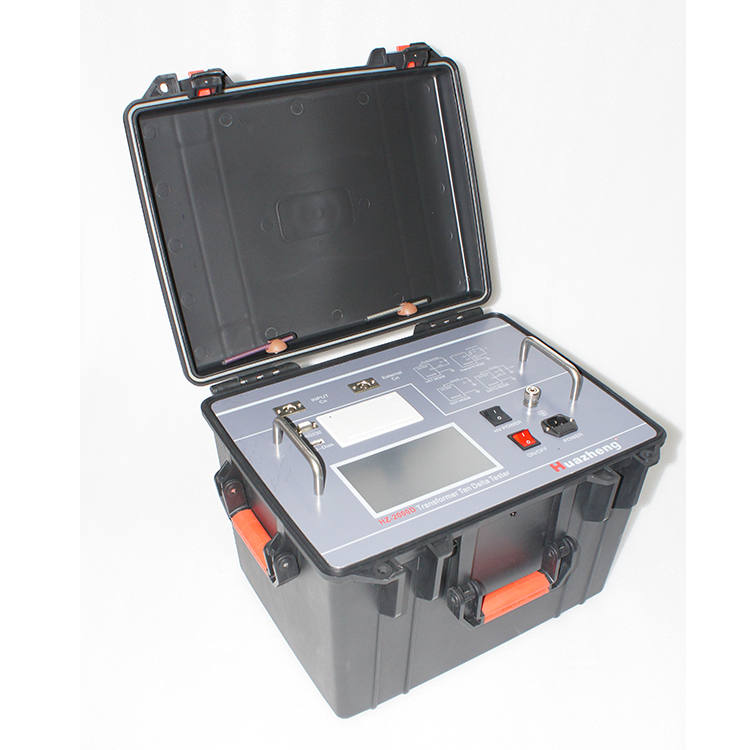
HZ-2000D Transformer Tan Delta Tester

 中文
中文
 English

 +86-312-6775656
 +86 13731210226
 sales03@bdhuazheng.com
