Danger of short circuit in power transformer
1. Impact of surge current: A sudden short-circuit of the transformer will produce a large short-circuit current. Although the duration is short, this hidden danger may have already formed before the main circuit of the transformer is cut off. After the formation, it may cause problems for the transformer. Internal damage, insulation degradation, etc.
2. Influence of electrodynamic force: During a short circuit, overcurrent will produce a large electrodynamic force, which will affect the stability. In severe cases, it will have a certain impact on the winding of the transformer, such as: winding deformation, damage to the insulation strength of the winding, and other components. It will also be damaged, and in severe cases, it may cause power safety accidents such as the burning of power transformers.
Causes of short circuit in power transformer
1. The current calculation program is based on idealized models such as uniform distribution of the leakage magnetic field, the same diameter of the wire turns, and equal-phase forces. In fact, the leakage magnetic field of the transformer is not uniformly distributed. In the iron yoke part Relatively concentrated, the mechanical force on the electromagnetic wires in this area is also large; the transposition wire will change the direction of force transmission due to climbing at the transposition location, and generate torque; due to the factor of the elastic modulus of the pad, the axial pad does not The equidistant distribution will cause the alternating force generated by the alternating leakage magnetic field to resonate with delay. This is also the fundamental reason why the wire cake at the core yoke, transposition, and corresponding parts with voltage regulating taps deforms first.
2. The use of ordinary transposed wires has poor mechanical strength and is prone to deformation, loose strands, and exposed copper when subjected to short-circuit mechanical force. When ordinary transposed wires are used, due to the large current and steep transposition climb, a large torque will be generated at this part. At the same time, the wire cake at both ends of the winding will also produce due to the joint action of the amplitude and axial leakage magnetic fields. Larger torque causes distortion and deformation. For example, the A-phase common winding of the Yanggao 500kV transformer has a total of 71 transpositions. Due to the use of thick ordinary transposition wires, 66 of them have varying degrees of deformation. In addition, the Wujing No. 1l main transformer uses ordinary transposed wires, and the two-end wire cakes of the high-voltage winding at the yoke of the core have different phenomena of flipping and exposing the wires.
3. The impact of temperature on the bending and tensile strength of the electromagnetic wire is not considered when calculating the short-circuit resistance. The short-circuit resistance designed at normal temperature cannot reflect the actual operating conditions. According to the test results, what is the temperature of the electromagnetic wire and its yield limit? 0.2 has a great influence. As the temperature of the electromagnetic wire increases, its bending resistance, tensile strength and elongation decrease. At 250℃, the bending and tensile strength decreases more than at 50℃, and the elongation decreases by 40%. above. In actual operating transformers, under rated load, the average winding temperature can reach 105°C, and the hottest spot temperature can reach 118°C. Generally, there is a reclosing process when the transformer is running. Therefore, if the short-circuit point cannot disappear for a while, it will bear the second short-circuit impact in a very short time (0.8s). However, due to the impact of the first short-circuit current, The winding temperature increases sharply. According to the regulations of GBl094, the maximum allowed is 250°C. At this time, the winding's short-circuit resistance ability has dropped significantly. This is why short-circuit accidents mostly occur after the transformer is reclosed.
4. The winding is loosely wound, improperly transposed, and too thin, causing the electromagnetic wire to hang in the air. Judging from the location of accident damage, deformation is often seen at transpositions, especially at transpositions of transposed wires.
5. The use of soft wires is also one of the main reasons for the poor short-circuit resistance of the transformer. Due to insufficient understanding of this in the early stage, or difficulties in winding equipment and technology, manufacturers were unwilling to use semi-rigid wires or had no requirements in this regard during design. Judging from the faulty transformers, they were all soft wires.
6. The gap between the sets is too large, resulting in insufficient support for the electromagnetic wires, which adds hidden dangers to the transformer's ability to withstand short circuits.
7. The pre-tightening force acting on each winding or each gear is uneven, causing the wire cake to jump during short-circuit impact, resulting in excessive bending stress acting on the electromagnetic wire and deformation.
8. The winding turns or wires are not cured, resulting in poor short-circuit resistance. None of the early paint-impregnated windings were damaged.
9. Improper control of the winding preload force causes the conductors of ordinary transposed conductors to be misaligned with each other.
10. External short-circuit accidents are frequent. The cumulative effect of electrodynamic force after multiple short-circuit current impacts causes the electromagnetic wire to soften or internal relative displacement, eventually leading to insulation breakdown.
Improvement measures to improve power transformer resistance to short circuit
1. Conduct a short circuit test on the transformer to prevent problems before they occur.
The operational reliability of large-scale transformers depends first on its structure and manufacturing process level, and secondly on conducting various tests on the equipment during operation to grasp the working conditions of the equipment in a timely manner. To understand the mechanical stability of the transformer, you can withstand short-circuit tests and improve its weak links to ensure that you are well aware of the structural strength of the transformer.
2. Standardize the design and pay attention to the axial compression process of coil manufacturing.
When designing, manufacturers should not only consider reducing the loss of the transformer and improving the insulation level, but also consider improving the mechanical strength and short-circuit fault resistance of the transformer. In terms of manufacturing technology, since many transformers use insulating pressure plates, and the high and low voltage coils share a pressure plate, this structure requires a high level of manufacturing technology. The pads should be densified, and the coils should be processed after the coils are processed. A single coil is dried at constant pressure and the height of the coil after compression is measured.
Each coil of the same pressure plate is adjusted to the same height after the above process, and a hydraulic device is used to apply the specified pressure to the coil during final assembly, and finally reaches the height required by the design and process. In the general assembly, in addition to paying attention to the compression of the high-voltage coil, special attention should be paid to the control of the compression of the low-voltage coil.
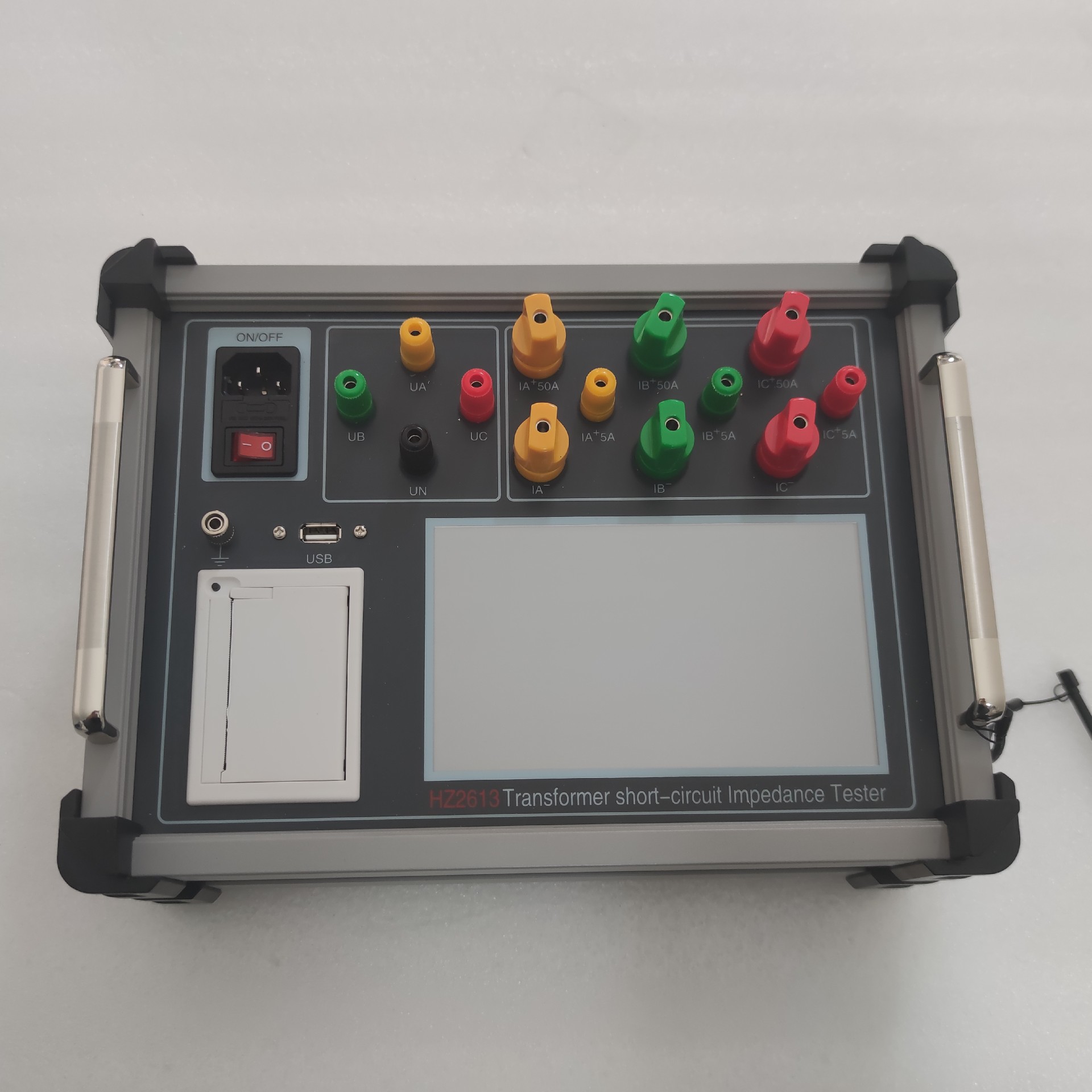
HZ2613 Transformer Short Circuit Impedance No Load Integrated Machine

 中文
中文
 English

 +86-312-6775656
 +86 13731210226
 sales03@bdhuazheng.com
