When dealing with transformer short-circuit accidents in daily operations, it is necessary to find out the essence of the problem through inspection and testing. When the transformer suffers a sudden short circuit, both the high and low voltage sides will be subject to a large short circuit current. In the short period of time before the circuit breaker has time to open, the short circuit current will generate an electric force proportional to the square of the current that will act on the windings of the transformer. Electric force can be divided into radial force and axial force. During a short circuit, the radial force acting on the winding will cause the high-voltage winding to be under tension and the low-voltage winding to be under pressure. Since the winding is round, round objects are more likely to deform under pressure than tension. Therefore, low-voltage windings are more likely to deform. The axial force generated during a sudden short circuit compresses the windings and causes axial displacement of the high and low voltage windings. The axial force also acts on the core and clamps. Therefore, when a transformer suffers a sudden short circuit, the low-voltage windings and balance windings are most likely to deform, followed by the high- and medium-voltage windings, iron cores, and clamps. In addition to checking the main windings, cores, clamps and other parts after a transformer short-circuit accident, you should also pay attention to a series of related issues during the treatment process:
■ Inspection and testing of windings
Because when the transformer is short-circuited, under the action of electrodynamic force, the windings are simultaneously subjected to various forces such as compression, tension, and bending. The faults caused by them are highly concealed and difficult to inspect and repair. Therefore, inspections should be focused after the short-circuit fault. Winding condition.
■ Measurement of transformer DC resistance
According to the measured value of the DC resistance of the transformer, checking the DC resistance unbalance rate of the winding and comparing it with the previous measured values can effectively examine the damage to the transformer winding. For example, after a short-circuit accident of a certain transformer, the C-direction DC resistance of the low-voltage side increased by about 10%. From this, it was judged that the winding may have new strands. Finally, the winding was lifted out for inspection and it was found that one strand of the C-phase winding was broken.
■ Measurement of transformer winding capacitance
The capacitance of the winding is composed of the inter-turn, inter-layer and inter-cake capacitance of the winding and the winding generating capacity. This capacitance is related to the gap between the winding and the iron core and the ground, the gap between the winding and the iron core, the gap between the winding turns, between the layers and between the cakes. When the winding is deformed, it generally bends in an "S" shape, which causes the gap distance between the winding and the iron core to become smaller, and the capacitance between the winding and the ground will become larger. Moreover, the smaller the gap, the greater the change in capacitance, so the winding The capacitance can indirectly reflect the degree of deformation of the winding.
■ Inspection after hanging hood
After the transformer is lifted, if there is molten copper slag, aluminum slag or fragments of high-density cable paper inside the transformer, it can be judged that the winding has undergone a large degree of deformation and strand breakage. In addition, the winding pad has been displaced. , falling off, pressure plate equalization, pressure nail displacement, etc. can also determine the degree of damage to the winding.
■ Inspection of iron core and clamps
The iron core of the transformer should have sufficient mechanical strength. The mechanical strength of the iron core is guaranteed by the strength of all clamping parts on the iron core and its connecting parts. When the winding generates electric power, the axial force of the winding will be offset by the reaction force of the clamp. If the strength of the clamp and the pull plate is less than the axial force, the clamp, pull plate and winding will be damaged. Therefore, the condition of the core, clamps, pull plates and their connections should be particularly carefully checked. Check the conditions:
① Check whether the yoke chip on the iron core moves up and down.
② The insulation resistance of the core-through screw and the iron core should be measured, check whether the core-through screw jacket is damaged, and check whether the pull plate and pull plate connecting parts are damaged.
③ When the transformer is short-circuited, displacement may occur between the pressure plate and the clamp, causing the ground connection piece of the iron yoke on the pressure plate and pressure nail to be broken or burned by overcurrent. Therefore, for the winding pressure plate, in addition to checking the damage of the pressure nail and pressure plate, you should also check whether the ground connection between the winding, the pressure nail and the upper iron yoke is reliable.
■ Analysis of transformer oil and gas
After the transformer suffers a short-circuit impact, a large amount of gas may accumulate in the gas relay. Therefore, after the transformer accident, the gas in the gas relay and the oil inside the transformer can be taken for laboratory analysis to determine the nature of the accident.
■ Things to pay attention to when dealing with transformer short-circuit faults
(1) When replacing insulating parts, the performance of the insulating parts should be ensured
During processing, test the performance of the replaced insulation parts, and they can only be used if they meet the requirements. In particular, attention should be paid to the insulation of the lead bracket wooden blocks. The wooden blocks should be placed in thermal transformer oil at about 80°C for a period of time before installation to ensure the insulation of the wooden blocks.
(2) The transformer insulation test should be carried out after the transformer has been filled with oil and has been stationary for 24 hours.
Since some damp insulation parts will be soaked in hot oil for a long time, the moisture will spread to the surface of the insulation. Therefore, insulation defects cannot be detected by testing after oiling. For example, on the low-voltage side of a 31.5MVA 110kV transformer, a wooden support block for the 10kV copper bar was replaced during processing. After the transformer was filled with oil, the test was normal. The insulation resistance of the 10kV low-voltage side to the core, clamps and ground was reduced to approximately 1 MΩ. Later, after inspection of the hanging hood, it was found that the insulation of the wooden brackets of the 10 kV copper bar was very low. Therefore, the insulation test should be carried out 24 hours after the transformer has been filled with oil and is more reliable.
(3) Pay attention to the sharp corners when reassembling the iron core.
When the iron core is reinstalled on the iron yoke, attention should be paid to the sharp corners of the core chip, and the insulation between the oil channels should be measured promptly. In particular, attention should be paid to the sharp corners of the chip at the oil channel to prevent the chips from overlapping and causing multi-point grounding of the iron core. For example, for a 120MVA 220kV transformer, when the winding is replaced on the low voltage side and the iron yoke is reinstalled, because the sharp corners of the chip are not paid attention to during the reassembly, and the insulation between the oil channels is not measured in time, the insulation between the oil channels is measured after the installation is completed. 0. It finally took a long time to find out that it was due to the sharp corner of the iron core chip shorting the oil passage.
(4) Replace the winding material with stronger short-circuit resistance
The mechanical strength of the improved structure transformer winding is mainly determined by the following two aspects:
① First, the mechanical strength of the winding is determined by factors of the winding’s own structure;
② The second is the mechanical strength determined by the support on the inner diameter side of the winding and the axial pressing structure of the winding, as well as the manufacturing processes such as pull plates and clamps. Currently, most transformer manufacturers use semi-rigid copper wires or self-adhesive transposed wires to improve the winding's own short-circuit resistance, and use better-quality cardboard tubes or increase the number of stays to improve the winding's ability to withstand radial forces. And use pull plates or spring pressure nails to improve the winding's ability to withstand axial force.
As the technical department of a power transformer manufacturer, during the technical demonstration before signing the transformer sales contract and when the transformer winding is replaced, the short-circuit resistance of the winding should be fully investigated and given sufficient attention.
(5) Drying of transformer
Since the transformer is generally required to be inspected for a long time after being hit by a short circuit, two measures can be taken to prevent the transformer from getting damp:
① First, before the end of work every day, cover the transformer and use a vacuum pump to evacuate the transformer to remove the free water on the surface of the transformer body. When work starts the next day, use dry nitrogen or dry air to release the vacuum. Generally, the transformer After the overhaul, the hot oil circulates for 24 hours and can be put into operation directly.
② Second, after work is completed every day, rainproof measures should be taken for the transformer. After the work is completed, the transformer should be dried using the hot oil spray method. This method generally takes 7 to 10 days.
(6) Other matters that should be noted
After a short-circuit accident occurs in a transformer, in addition to testing the transformer according to conventional projects, the nature of the fault should be judged and analyzed based on the test results of transformer oil, gas in the gas relay, winding DC resistance, winding capacitance, and winding deformation measurement, and check Deformation of the winding, displacement and looseness of the core and clamps, and then determine the treatment plan for the transformer and the preventive measures that should be taken. When the winding is severely deformed due to a short-circuit accident in the transformer and needs to be replaced, attention should be paid to the reassembly of the core chips, the drying of all insulating parts, the treatment of transformer oil and the overall drying of the transformer.
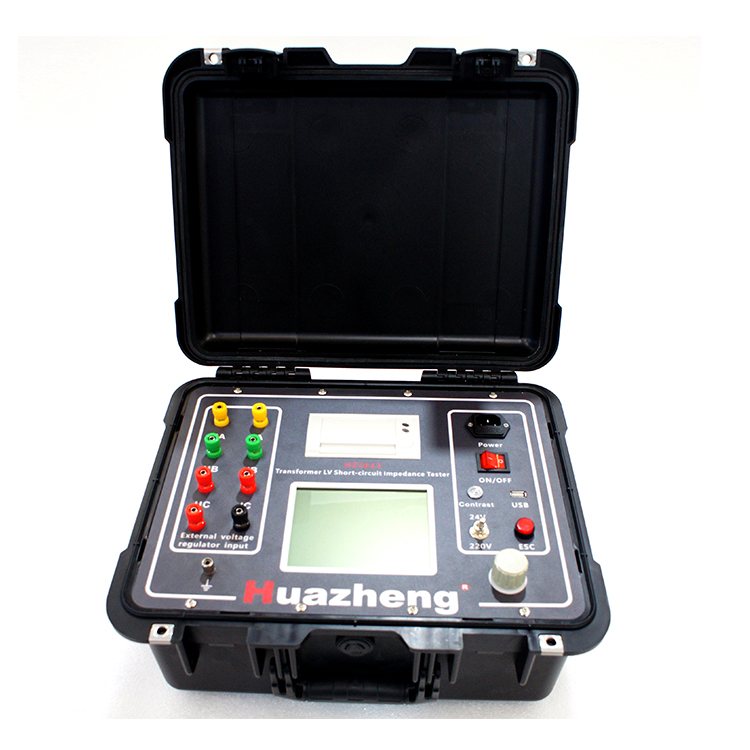
HZ2612 Transformer Short Circuit Impedance Tester

 中文
中文
 English

 +86-312-6775656
 +86 13731210226
 sales03@bdhuazheng.com
