■ Advantages and disadvantages of dry-type transformers and oil-immersed transformers
In terms of price, dry change is more expensive than oil change.
In terms of capacity, large-capacity oils produce more oil than dry ones.
Dry inverters need to be used in complex buildings (basements, floors, roofs, etc.) and in crowded places. Oil transformers are used in independent substations.
The transformer inside the box transformer is generally a box transformer. Oil transformers are generally used for temporary outdoor electricity use.
During construction, dry and oil transformers are selected according to the space. When the space is large, oil transformers can be selected, and when the space is crowded, dry transformers can be selected.
The regional climate is relatively humid and hot, so it is easy to use oil. If dry conversion is used, forced air cooling equipment must be installed.
1. Appearance
The packaging forms are different. For dry-type transformers, the core and coil can be directly seen, while for oil-type transformers, only the shell of the transformer can be seen;
2. Different lead forms
Most dry-type transformers use silicone rubber bushings, while most oil-type transformers use porcelain bushings;
3. Different capacities and voltages
Dry-type transformers are generally suitable for power distribution. Most of the capacities are below 1600KVA and the voltage is below 10KV. Some of them can reach 35KV voltage level. However, oil-type transformers can have full capacity from small to large and all voltage levels. Voltage; the ultra-high voltage 1000KV test line under construction in our country must use oil-type transformers.
4. Insulation and heat dissipation are different
Dry-type transformers are generally insulated with resin and rely on natural air cooling, and large capacity is cooled by fans, while oil-type transformers are insulated by insulating oil. The circulation of insulating oil inside the transformer transfers the heat generated by the coil to the radiator (sheet) of the transformer. for heat dissipation.
5. Applicable places
Dry-type transformers are mostly used in places that require "fire protection and explosion-proof", and are generally easy to use in large buildings and high-rise buildings; while oil-type transformers are mostly used outdoors because oil may spurt out or leak after an "accident", causing a fire. And there are places where "accident oil pools" are dug.
6. Different load bearing capabilities
Generally, dry-type transformers should operate at rated capacity, while oil-type transformers have better overload capabilities.
7. The cost is different
For transformers of the same capacity, the purchase price of dry-type transformers is much higher than that of oil-type transformers.
Dry-type transformer models generally start with SC (epoxy resin cast encapsulated type), SCR (non-epoxy resin cast solid insulation encapsulated type), SG (open type)
■ The difference between dry-type transformers and oil-immersed transformers
"Of course, the same thing is that they are all power transformers. They all have iron cores for magnetic circuits and windings for circuits. The biggest difference is between "oil type" and "dry type." That is to say, the cooling medium between the two is different. The former uses transformer oil (of course there are other oils such as beta oil) as the cooling and insulating medium, and the latter uses air or other gases such as SF6 as the cooling medium. The oil transformer places a device body composed of an iron core and windings In a tank filled with transformer oil. Dry transformers usually encapsulate the core and windings with epoxy resin. There is also a non-encapsulated type that is more commonly used now. The windings are impregnated with special insulating paper. Insulating paint, etc., can prevent the winding or iron core from getting wet. (And because the two are derived from different categories due to different classification methods in terms of process, use, and structure, we use a narrow perspective)
In terms of output and usage, the current voltage level of dry transformers is only 35kV, and the capacity is smaller than that of oil transformers, which is about 2500kVA. In addition, the manufacturing process of dry transformers is more complicated than that of oil transformers with the same voltage level and capacity. , the cost is also high. So currently, in terms of dosage, there is still more oil. However, due to the environmental protection, flame retardancy, impact resistance and other advantages of dry transformers, they are often used in indoor and other high-demand power supply and distribution places, such as hotels, office buildings, high-rise buildings, etc. If you are just a transformer user, it should be enough to know this.”
Each has its own advantages and disadvantages. Oil-based transformers are low-cost and easy to maintain, but they are flammable and explosive. Due to its good fire resistance, dry transformers can be installed in the load center area to reduce voltage loss and power loss. However, dry conversion is expensive, bulky, has poor moisture and dust resistance, and is noisy.
The oil changer gradually exits, and a dry changer is used. The dry changer can be disassembled for transportation and convenient, clean and easy to maintain. It does not require a machine base for installation, and there is no oil leakage pool. Other advantages
It is relatively easy to distinguish from appearance;
The biggest difference between oil-immersed transformers and dry-type transformers is whether there is "oil". Since oil is liquid and has fluidity, oil-immersed transformers must have a shell. Inside the shell is transformer oil, and the transformer is soaked in the oil. The coils of the transformer cannot be seen from the outside; while dry-type transformers have no oil, so there is no need for a shell, and the coils of the transformer can be directly seen; another feature is that there is an oil pillow on the oil-immersed transformer, which is stored inside. transformer oil, but now new oil-immersed transformers are also produced without oil pillows;
In order to facilitate heat dissipation, that is, to facilitate the flow of internal insulating oil and heat dissipation, oil-immersed transformers are designed with a radiator on the outside, just like a heat sink. However, dry-type transformers do not have this radiator. The heat dissipation relies on the fan under the transformer coil. The fan is somewhat like the indoor unit of a household air conditioner;
Due to the need for fire protection, oil-immersed transformers are generally installed in a separate transformer room or outdoors, while dry-type transformers must be installed indoors, usually in low-voltage distribution rooms, and installed side by side with low-voltage distribution cabinets.
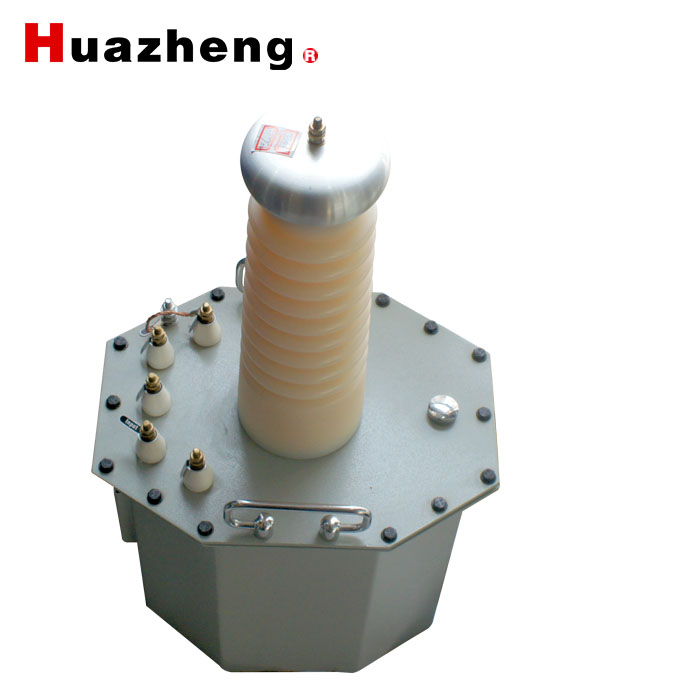
HZJ Oil Type Testing Transformer

 中文
中文
 English

 +86-312-6775656
 +86 13731210226
 sales03@bdhuazheng.com
