An electrical appliance that uses a metal conductor as a melt connected in series in a circuit. When an overload or short-circuit current passes through the melt, it heats up and melts, thus breaking the circuit. Fuses have a simple structure and are easy to use. They are widely used as protection devices in power systems, various electrical equipment and household appliances.
Main categories
Plug-in fuse: It is often used at the end of lines with voltage levels of 380V and below as short-circuit protection for distribution branches or electrical equipment.
Spiral fuse: There is a fuse indicator on the upper end cap of the melt. Once the melt melts, the indicator pops up immediately and can be observed through the glass hole in the porcelain cap. It is often used in electrical control equipment of machine tools. Screw type fuse. The breaking current is large and can be used for short circuit protection in circuits with voltage levels of 500V and below and current levels of 200A and below.
Sealed fuses: Sealed fuses are divided into two types: filled fuses and unfilled fuses, as shown in Figures 3 and 4. Filled fuses generally use square porcelain tubes filled with quartz sand and melt. They have strong breaking capacity and are used in circuits with voltage levels below 500V and current levels below 1KA. The filler-free sealed fuse packs the melt into a sealed cylinder and has a slightly smaller breaking capacity. It is used in power grids or distribution equipment below 500V and below 600A.
Fast fuse: Fast fuse is mainly used for short circuit protection of semiconductor rectifier components or rectifier devices. Because the overload capacity of semiconductor components is very low. It can only withstand a large overload current in a very short time, so the short circuit protection is required to have the ability to blow quickly. The structure of the quick-acting fuse is basically the same as that of the filled sealed fuse, but the melt material and shape are different. It is a variable-section melt with a V-shaped deep groove punched from a silver sheet. Fast-acting fuses are often referred to as "quick-blow" and are characterized by fast fusing speed, large rated current, strong breaking capacity, stable current limiting characteristics, and small size.
Resettable fuse: Using metallic sodium as melt, it has high conductivity at room temperature. When a short-circuit fault occurs in the circuit, the short-circuit current generates high temperature, causing the sodium to quickly vaporize, and the vaporized sodium presents a high-resistance state, thereby limiting the short-circuit current. When the short-circuit current disappears and the temperature drops, metallic sodium returns to its original good conductive properties. Resettable fuses can only limit short-circuit current and cannot actually break the circuit. The advantage is that there is no need to replace the melt and it can be reused.
Performance comparison of fuses and circuit breakers
Fuse:
1. Main advantages and characteristics of fuses
①Good selectivity. As long as the rated current of the fuse link of the upper and lower level fuses meets the requirements of the overcurrent selection ratio of 1.6:1 stipulated in the national standard and IEC standard, that is, the rated current of the upper level fuse link is not less than 1.6 times of the value of the lower level, it is regarded as the upper and lower level fuses. Selectively cut off fault current;
②Good current limiting characteristics and high breaking capacity;
③Relatively small size;
④The price is cheaper.
2. Main disadvantages and weaknesses of fuses
① The fuse link must be replaced after the faulty fuse blows;
② The protection function is single, with only a section of overcurrent inverse time characteristics. This protection is used for overload, short circuit and ground fault;
③ When one phase fuse occurs, the adverse consequences of two-phase operation of the three-phase motor will be caused. Of course, a fuse with an alarm signal can be used to make up for it. The fuse of one phase can disconnect the three phases;
④Remote control cannot be realized and it is possible only by combining it with the electric knife switch and switch.
Non-selective circuit breaker:
1. Main advantages and features
① After the fault is disconnected, it can be manually reset without replacing components, unless maintenance is required after cutting off the large short-circuit current;
② Long-time delay release and instantaneous current release with inverse time characteristics have two-stage protection functions, which are used for overload and short-circuit protection respectively, and each performs its own duties;
③Remote control can be achieved when the electric operating mechanism is installed.
2. Main shortcomings and weaknesses
① It is difficult to selectively cut off the non-selective circuit breakers of the upper and lower levels. When the fault current is large, it is easy to cause both the upper and lower level circuit breakers to be disconnected instantaneously;
②The relative price is slightly higher;
③Some circuit breakers have small breaking capacity. If a circuit breaker with a small rated current is installed close to a large-capacity transformer, the breaking capacity will be insufficient. Existing products with high breaking capacity can meet the requirements, but the price is higher.
Selective circuit breaker:
1. Main advantages and features
① It has the above advantages of non-selective circuit breakers;
② It has a variety of protection functions, including long-time delay, instantaneous, short-time delay and ground fault (including zero-sequence current and residual current protection) protection, respectively realizing overload, circuit-breaking delay, large short-circuit current instantaneous action and ground fault protection. The protection sensitivity is extremely high, it is convenient to adjust various parameters, and it is easy to meet various protection requirements of distribution lines. In addition, it can have cascade protection function and have better selective action performance;
③ Most of today’s products have intelligent features. In addition to protection functions, they also have power measurement, fault recording, and communication interfaces to realize centralized monitoring and management of power distribution devices and systems.
2. Main issues
① The price is very high, so it should only be used at the head end of distribution lines and branch lines in particularly important places;
②The size is larger.
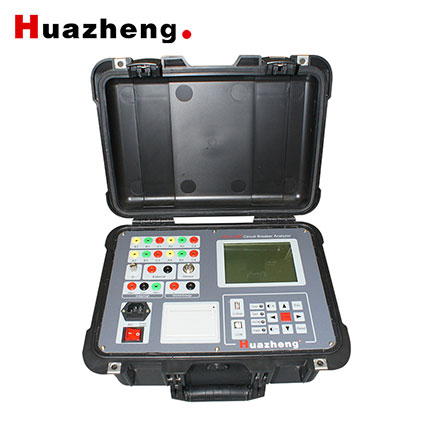
HZC-3980 Circuit Breaker Analyzer

 中文
中文
 English

 +86-312-6775656
 +86 13731210226
 sales03@bdhuazheng.com
